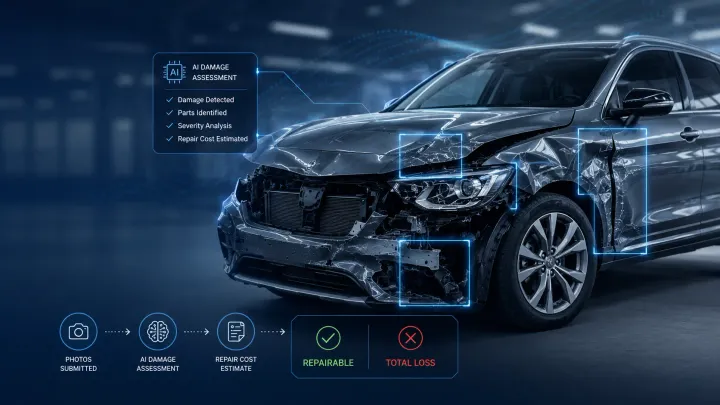
How AI Detects and Estimates Hail Damage on Cars
The most crucial component of hail damage repair is to secure a reliable and accurate damage assessment report. As technology advances, car damage detection using deep learning will soon become the norm in the industry.
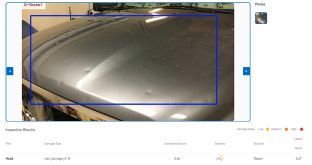
Hail damage on a car is assessed by identifying dents across every affected panel, measuring dent size, counting dents per area, and evaluating glass and trim damage. The combined findings feed a repair estimate or insurance claim. Inspektlabs' AI hail damage detector does all of this automatically from photos and video, measuring dents between 10mm and 100mm across all major vehicle panels.
This blog explains what hail does to a vehicle, how hailstone size correlates with damage severity, how hail damage is assessed, both manually and with AI, how repair estimates are built from that assessment, and how insurers handle catastrophe-level claim volumes after a major storm.
What Hail Does to a Vehicle
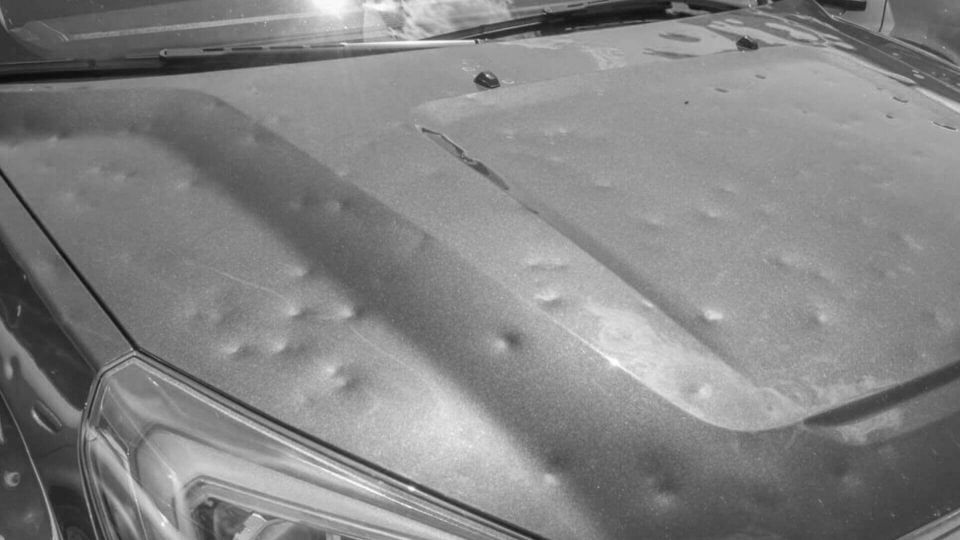
Hail causes four categories of vehicle damage. The Insurance Information Institute reports that the annual cost to the US insurance industry from hail damage has averaged between $8 billion and $14 billion over the past two decades. Hail-related auto claims are also 26% more costly to repair than the average repairable claim, according to CCC Intelligent Solutions data cited by Insurify (2026).
Panel dents: The most common outcome. Hail strikes horizontal surfaces hardest. The hood, roof, and boot lid typically absorb the most damage. Door panels and wings take lateral impact from bouncing hailstones.
Glass damage: Smaller hailstones chip windshields. Larger ones crack or shatter them. Sunroofs are particularly vulnerable.
Interior and water damage: Cracked seals and broken glass allow water ingress. Interior damage follows. Electrical systems can be affected in severe cases.
Resale value reduction: Even repaired hail damage is documented on vehicle history records. Visible dent patterns, known as 'orange peel' texture on repainted panels, reduce resale value even when the vehicle is structurally sound.
Hailstone Size and Damage Severity
Hailstone size is the primary indicator of damage severity. Assessors use coin and ball comparisons as the standard reference. The threshold that matters most for claims is the one-inch mark. Hailstones of one inch or above are classified as severe by NOAA.
Dent size drives the repair decision. Smaller dents under one inch in depth are typically paintless dent repair (PDR) candidates. PDR is less disruptive and significantly cheaper than panel replacement. Once paint is damaged, or dents are too deep for PDR tools to access, the cost escalates.
Golf ball size hail and above often pushes claim values into the range where total loss assessment becomes relevant. An adjuster seeing a vehicle with hundreds of golf ball dents across every horizontal panel will begin calculating whether repair cost exceeds a percentage of the vehicle's actual cash value.
How Hail Damage Is Assessed: Manual vs AI
Manual hail damage assessment follows a structured walk-around process. The adjuster or technician documents damage by panel, records dent size and count, and notes glass or trim damage separately. This is the standard against which AI assessment is measured.
Manual assessment: step by step
- Park the vehicle in good lighting. Natural diffused light or a specialist dent light is used to make shallow dents visible.
- Walk around all horizontal surfaces first. Hood, roof, boot lid, and bonnet take the most direct impact.
- Check door panels and wings for lateral bounce damage.
- Inspect all glass components: windshield, rear window, side windows, sunroof.
- Count and measure dents per panel. Record dent size in millimetres or inches.
- Check trim, mirrors, lights, and aerials for secondary damage.
- Compile findings into a written or digital report.
The limitations of this process are well established. Two assessors examining the same vehicle rarely produce identical dent counts. Shallow dents are missed without specialist lighting. The written report takes time to compile and introduces further inconsistency.
AI Damage Detection
Detect hail damage in minutes
Automatically identify dents and generate consistent damage reports from photos.
AI hail damage assessment: the contrast
For more on how the AI model processes vehicle imagery, see how Inspektlabs AI detects vehicle damage.
How AI Detects Hail Damage
Inspektlabs' AI vehicle damage detection analyses photos and video captured through a guided smartphone flow to identify hail damage across vehicle panels. No specialist equipment is required. No trained assessor needs to be present.
The AI identifies hail damage on all major exterior panels: hood, roof, boot lid, all door panels, front and rear wings. It counts individual dents on each panel and calculates the average dent size in the 10mm to 100mm range. The detection runs across all panels simultaneously in a single processing pass.
The output is a structured hail damage appraisal. It lists every affected panel, the dent count per panel, the average dent size, and flags for glass damage where visible. The report is generated in approximately 90 seconds from media submission.
The detector distinguishes between pre-existing damage and new hail impact patterns. This is operationally significant for two reasons. First, it protects insurers from claims that include pre-existing dents attributed to a recent storm. Second, it gives fleet operators an accurate baseline before and after any weather event.
The model is trained on hail damage imagery across vehicle types, markets, and storm severity levels. For the full technical methodology, see Inspektlabs Core Technology.
Hail Damage Repair Cost Estimation
Repair cost estimation starts with the output of the damage assessment. Dent count and average dent size per panel are the two primary inputs. Secondary inputs are glass damage, trim replacement, and the presence of paint damage that rules out PDR.
PDR vs panel replacement
PDR is the preferred repair method when hailstones are smaller than one inch and the paint surface is intact. A skilled PDR technician can remove dents by working from behind the panel without disturbing the paint. PDR costs between $30 and $75 per dent for standard work. A vehicle with 50 minor dents across the hood and roof might receive a PDR estimate in the $1,500 to $3,500 range.
When dents exceed the PDR threshold, or when paint is chipped or cracked, panel repair or replacement is required. Costs rise significantly. A vehicle with multiple panels requiring respray and severe glass damage can reach $4,000 to $8,000 or more.
Total loss thresholds vary by insurer, but as a general guide, when repair cost exceeds 70 to 80% of the vehicle's actual cash value, insurers assess the vehicle for total loss. Average hail claim payouts in 2021 reached approximately $5,000, reflecting increasingly severe storm patterns, according to industry data compiled by Global Public Adjusters.
How AI supports cost estimation
An AI-generated hail damage appraisal feeds directly into repair estimation tools. Dent count and size per panel, combined with panel location and vehicle-specific repair rates, produce an automated estimate. This replaces the manual process of measuring each dent individually and entering findings into a repair pricing matrix. For insurers, this reduces auto hail damage estimation from a multi-day process to a same-session output.
Handling Hail Claims at Scale
A single significant hailstorm can produce thousands of vehicle damage claims within 48 hours. NOAA's Storm Prediction Center recorded 5,432 hail events in 2025. After a major event in a densely populated area, the claim surge overwhelms manual assessment capacity. Adjusters are booked out for weeks. Policyholders wait. Settlement delays drive customer dissatisfaction and increase claim management costs.
Photo-based assessment at the catastrophe scale
AI inspection removes the dependency on field adjuster availability. Policyholders submit photos of their vehicle through a guided app. The AI assesses all panels, counts and measures dents, flags glass damage, and generates a condition report. The insurer receives a structured, verifiable damage record without deploying a single field adjuster.
This is not a replacement for all claims. High-value or disputed claims still benefit from human review. But for the majority of standard hail claims, photo-based AI assessment delivers the same output faster and at significantly lower cost per claim.
Faster settlement
The assessment bottleneck is where claims slow down after a storm. When the AI handles initial assessment, the insurer can triage claims by severity immediately. Low-complexity claims that meet STP criteria move to settlement without adjuster involvement. More complex cases are flagged and prioritised for human review. This turns a weeks-long post-storm backlog into a process that clears in days.
Fraud filtering
Catastrophe events create fraud pressure. Some policyholders attribute pre-existing damage to the storm. Some submit claims for vehicles that were not in the affected area. AI inspection addresses both. The detector identifies dent patterns inconsistent with hail impact. It cross-references submission metadata against the reported event location and date. Timestamped reports generated at or near the time of the event create an evidence trail that is harder to manipulate than a written adjuster report filed days later.
Related: The Role of AI in Motor Insurance Claim Automation | Inspektlabs Damage Detection.
Accurate Assessment Is Where Hail Claims Are Won or Lost
Accurate hail damage assessment determines the repair path, the claim value, and whether fraud is caught before settlement. AI makes that assessment fast, consistent, and scalable to any storm volume.
Whether you are managing a single claim or a post-storm surge of thousands, the assessment quality at the start determines the cost and speed of everything that follows.
Frequently Asked Questions
- How is hail damage assessed on a car?
An assessor inspects all exterior panels for dents, measuring dent size and counting dents per area. Glass and trim damage is recorded separately. The findings feed a repair estimate or insurance claim. AI assessment does the same process automatically from photos, with a report generated in under two minutes. - Can AI detect hail damage on a vehicle?
Yes. Inspektlabs' AI hail damage detector identifies hail damage on all major panels. It counts dents per panel and measures average dent size between 10mm and 100mm. The output is a structured condition report generated in approximately 90 seconds. - How do you check a car for hail damage?
Inspect the vehicle in good light, ideally diffused natural light or a specialist dent light. Check all horizontal surfaces first: hood, roof, and boot lid. Then check door panels, glass, trim, and mirrors. Look for shallow indentations that may be hard to see straight on. Viewing panels at a low angle makes dents easier to spot. - How is hail damage repair cost estimated?
Repair cost is based on dent count, average dent size, and whether the paint is intact. Small dents with intact paint are PDR candidates at $30 to $75 per dent. Larger or paint-damaged dents require panel repair or replacement. Average hail claim payouts reached approximately $5,000 in 2021, reflecting increasingly severe storm patterns. - Can a hailstorm total a car?
Yes. When repair cost exceeds 70 to 80% of the vehicle's actual cash value, most insurers classify the vehicle as a total loss. Golf ball sized hail and above can trigger this threshold on older or lower-value vehicles, particularly when multiple panels require replacement. - Do insurers use AI to handle hail damage claims?
Yes, increasingly. AI photo inspection allows policyholders to submit images after a storm. The AI assesses damage and generates a report without a field adjuster visit. This is particularly valuable after major hail events, where claim volume far exceeds manual adjuster capacity. - Can you tell how old hail damage is on a car?
Experienced assessors can identify signs of older hail damage, such as rust at the base of dents or paint fading inconsistent with the surrounding panel. AI inspection provides a timestamped report at the point of submission, which establishes when damage was documented. This makes it significantly harder to attribute pre-existing damage to a recent storm.