The Role of AI in Motor Insurance Claim Automation
Inspektlabs has built four practical implementations of Insurance claim automation. These use cases combine AI with human oversight where needed, helping insurers automate large parts of the claims workflow while maintaining accuracy.
The Motor Insurance industry is rapidly adopting insurance claim automation as companies look for faster and more efficient ways to process claims. Technologies powered by AI claim systems are helping insurers reduce processing time, improve consistency, and scale operations without increasing manual workload.
However, claim processing has always been complicated because of the variability involved in car damage assessments. Pre-existing damage may not always be identified during inspections. Internal damage can be difficult to detect from images alone. Even the same assessor may produce slightly different reports when reviewing the same images on different occasions.
AI is helping reduce some of the subjectivity through automated vehicle damage detection. By analyzing photos or videos of a vehicle, AI systems can identify damaged components and generate repair estimates faster and more consistently. This is why AI in auto insurance is becoming an important tool for modern claims operations.
At the same time, AI has its own limitations. Minor damage can sometimes be missed and internal damage is not always visible through images. Because of this, achieving fully touchless claims for every scenario is not realistic today.
Keeping these challenges in mind, Inspektlabs has built four practical implementations of Insurance claim automation. These use cases combine AI with human oversight where needed, helping insurers automate large parts of the claims workflow while maintaining accuracy.
Understanding Inspektlabs' AI-powered claim estimation: Use cases
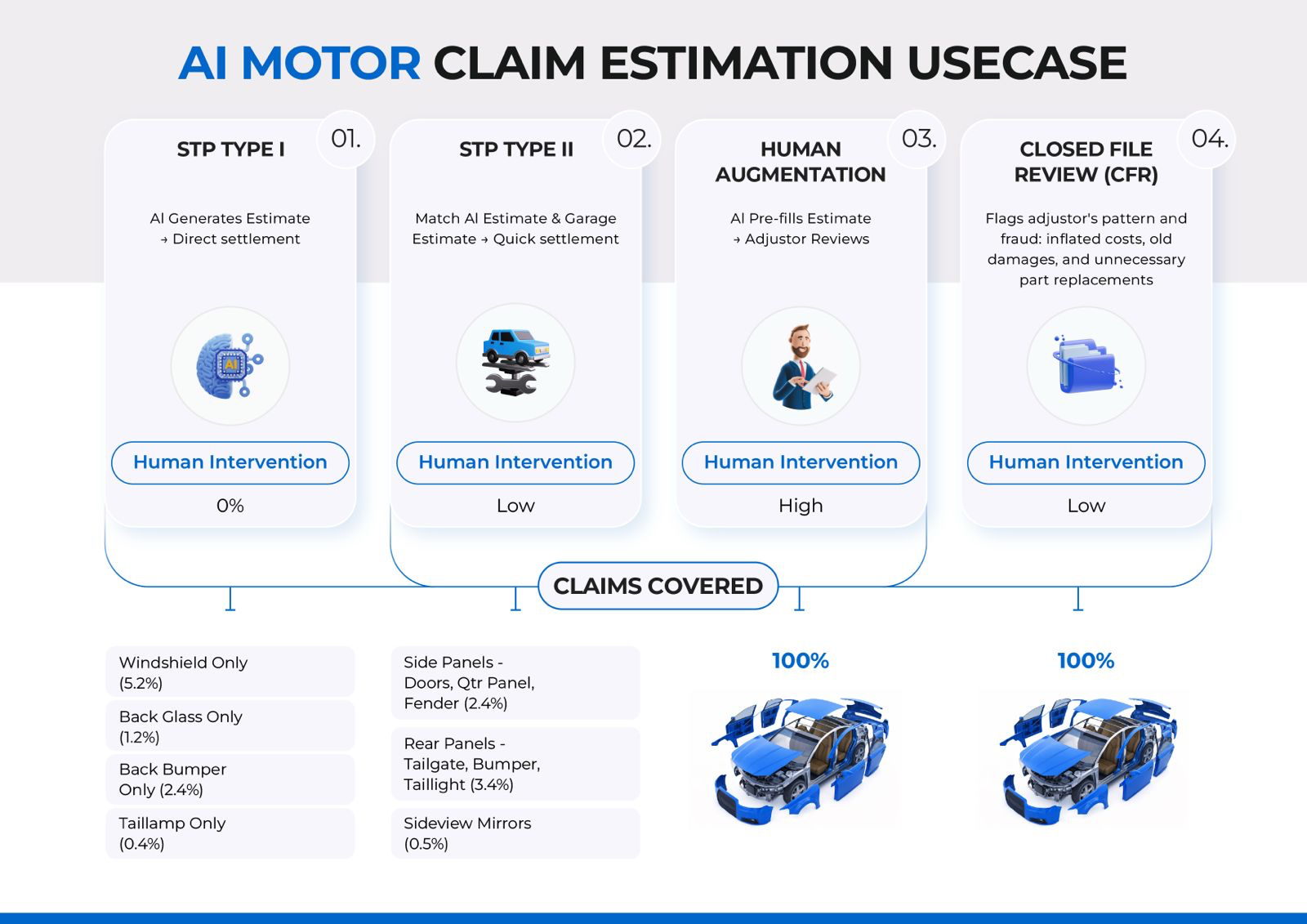
Inspektlabs focuses on the practical implementation of Insurance Claim automation that supports different levels of claim complexity. Each use case relies on vehicle damage detection and AI-driven car damage assessment, while introducing human validation when needed.
#1 - STP Type 1: Fully automated claims
Straight Through Processing Type 1 enables fully touchless claims for simple and clearly identifiable damage.
In this workflow, the vehicle owner scans their vehicle using a smartphone. The AI systems performs vehicle damage detection and generates a repair estimate instantly.
If the damage falls within predefined conditions, the claim is approved automatically without human intervention. This allows insurers to process AI claims within seconds.
This model works best for straightforward damage such as:
- Windshield damage
- Rear glass damage
- Tail light damage
- Rear bumper damage
Since these repairs are predictable, they are ideal candidates for insurance claim automation and automated claim approvals.
#2 - STP Type 2: Automated claims with Validation
Some claims involve more components and require additional verification.
STP Type 2 expands Insurance claim automation to these scenarios while still maintaining efficiency.
The process begins with the customer scanning the vehicle. The AI system performs vehicle damage detection and generates an initial car damage assessment along with a repair estimate.
The vehicle is then inspected by a repair garage which produces its own estimate.
The AI system compares both estimates. If the two estimates fall within an acceptable variance range, the system automatically approves the claim.
This workflow allows insurers to scale AI claims processing while maintaining confidence in the repair estimates.
Typical damages handled under this process include:
- Side panels, such as doors and fenders
- Rear panels such as bumpers and tailgates
- Side view mirrors
- Tail light assemblies
By combining automated car damage assessment with validation, insurers can accelerate claims processing without sacrificing accuracy.
#3 - Human Augmentation: AI-assisted claim review
Some claims require deeper analysis and cannot be fully automated.
In these situations, the human augmentation workflow allows insurers to combine AI claims technology with expert review.
The AI system first performs vehicle damage detection and generates a repair estimate based on its car damage assessment.
An insurance adjustor then reviews the estimate and can modify it if necessary. The adjustor may adjust repair costs, add damages that were missed, or include internal damage that cannot be detected through images.
This approach allows insurers to benefit from the efficiency of AI in auto insurance while ensuring complex claims receive expert evaluation.
Rather than replacing adjustors, AI helps them work faster and more consistently.
#4 - Closed File Reviews: AI-powered claim audits
AI can also improve how insurers analyze completed claims.
Closed File Reviews focus on evaluating claims that have already been processed and approved. These reviews help insurers identify inconsistencies and improve adjustor performance.
Traditionally, insurers review only a small percentage of claims because manual audits are time-consuming.
With Insurance claim automation, AI can analyze historical claims data at scale. The system can detect patterns such as inflated repair costs, inconsistent car damage assessment, or unnecessary part replacements.
Using AI claims analysis, insurers gain insights that help refine their claims workflows and improve operational efficiency.
How These Use Cases Fit into a Claims Workflow
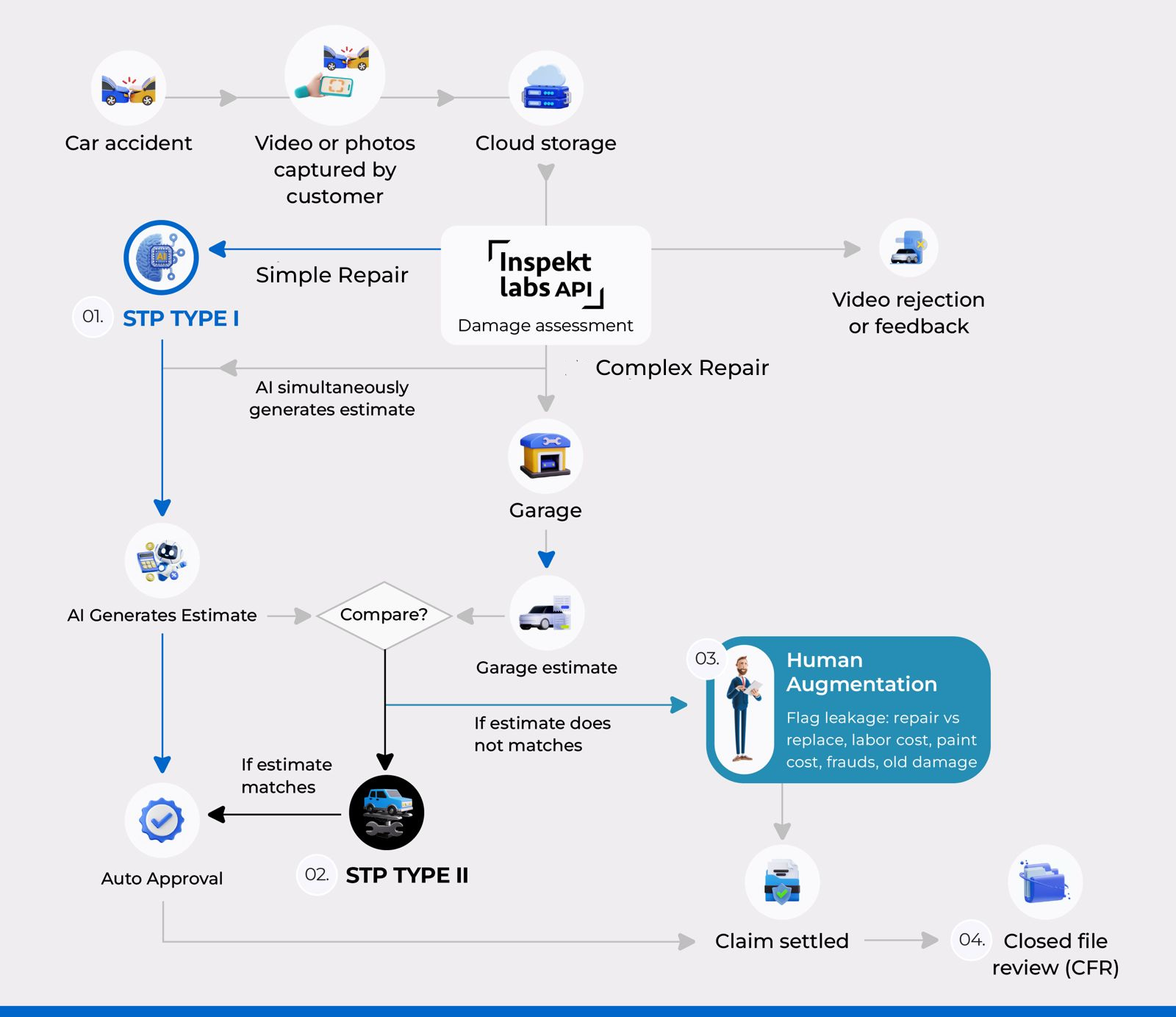
The real value of Inspektlabs’ Insurance claim automation lies in how these implementations work together in a structured workflow.
Step 1: Simple Damage
When damage is straightforward, insurers can use STP Type 1 to enable touchless claims.
For example, windshield or tail light damage often requires simple replacement. Automated vehicle damage detection can quickly perform the car damage assessment and approve the claim immediately.
Step 2: Moderately Complex Damage
When damage involves multiple components, the claim moves to STP Type 2.
The AI system performs the initial inspection and generates an estimate. The vehicle is then inspected at a repair garage.
Once the garage estimate is available, the AI compares both estimates. If the estimates fall within an acceptable range, usually within five percent, the system approves the claim automatically.
This allows insurers to maintain both speed and accuracy in AI claims processing.
Step 3: Large Estimate Differences
If the difference between the AI-generated estimate and the garage estimate is significant, the claim moves to the human augmentation stage.
An adjustor reviews both estimates, identifies discrepancies, and makes the necessary corrections on the dashboard before approving the claim.
This ensures that AI in auto insurance continues to support the workflow while complex cases receive expert attention.
Step 4: Continuous Improvement Through CFR
After claims are completed, the Closed File Review process helps insurers evaluate historical claims.
AI models analyze past claims data to identify patterns in adjustor behavior and opportunities for improvement. These insights help insurers refine their Insurance claim automation strategy and improve consistency in car damage assessment.
Benefits of Using AI-Powered Insurance Claim Automation
Adopting AI-powered Insurance Claim automation brings several operational advantages for insurers.
Faster Claim Processing
AI-driven Vehicle Inspections allow insurers to generate vehicle repair estimates and complete Claim Estimationwithin seconds, dramatically reducing claim processing time.
Lower Operational Costs
By automating damage detection and estimate generation, insurers can reduce the manual effort required to calculate auto repair insurance cost, allowing adjustors to focus on more complex cases.
Improved Estimation Accuracy
AI models analyze thousands of claims datasets, enabling consistent and standardized vehicle repair estimates across different claim scenarios.
Better Fraud Detection
AI-powered analysis can identify suspicious patterns in claims data, including inflated repair costs or inconsistent estimates.
Scalable Claims Operations
With modern auto insurance claims software, insurers can process a higher volume of claims without increasing operational overhead.
Conclusion
As insurers modernize their operations, Insurance claim automation is becoming essential for faster and more scalable claims processing.
While fully touchless claims are possible for simple damage scenarios, the variability involved in car damage assessment means that automation must often work alongside human expertise.
By combining advanced vehicle damage detection with intelligent workflows and human oversight, AI in auto insurance is helping insurers build faster, more reliable, and more efficient claims operations.
Solutions like those developed by Inspektlabs allow insurers to deploy practical AI claims workflows that automate large portions of the claims lifecycle while maintaining accuracy and control.