From STP to Fast Track: How AI Is Cutting Insurance Claim Payout Time
In this blog, we talk about the steps involved in the claims process and how AI can help automate some of these processes for faster payouts.

Manual claims processing remains slower than most insurers would like. It takes time, increases operational cost, and often frustrates policyholders waiting for updates.
On average, insurers spend $40 to $60 per claim, and resolution can take up to 10 days. That delay adds up quickly across high claim volumes.
This is where AI-powered insurance solutions change the equation. By leveraging models like Straight-Through Processing (STP) and fast-track claims, insurers can automate claims, reduce operational costs, and deliver a better customer experience.
This article explains how each model works, which claims qualify for which route, and what it takes to implement them in practice.
Why Faster Claims Processing Is Now a Business Imperative
The financial case is clear. An article by MoneyGeek shows that among insurers using AI in claims, average processing time dropped from 10 days to 36 hours. Cost per claim falls from $40-60 to $25-36 with AI assistance. That is a 30 to 40% reduction per claim. Across thousands of claims a year, the saving is significant.
The customer experience cost matters just as much. Insurers using intelligent claims assistance report a 63% increase in customer satisfaction. Claims are the moment of truth in the insurer-policyholder relationship. A slow or opaque process at that point damages retention more than almost any other interaction.
The operational drag is the third factor. Manual document handling accounts for up to 80% of total time spent processing a claim. That is experienced claims staff allocated to data entry, file retrieval, and report formatting. AI handles those tasks in seconds, freeing the same staff for complex cases where human judgement is genuinely needed.
While slow claims processing is one challenge, insurers are also dealing with rising repair costs, insurance fraud, and increasing claims complexity.
Learn more about the biggest challenges facing motor insurers and how AI helps address them - Challenges motor insurance companies need to tackle.
The Traditional Claims Process (And Where AI Changes It)
The standard motor insurance claims workflow involves eight steps. Each one creates a delay.
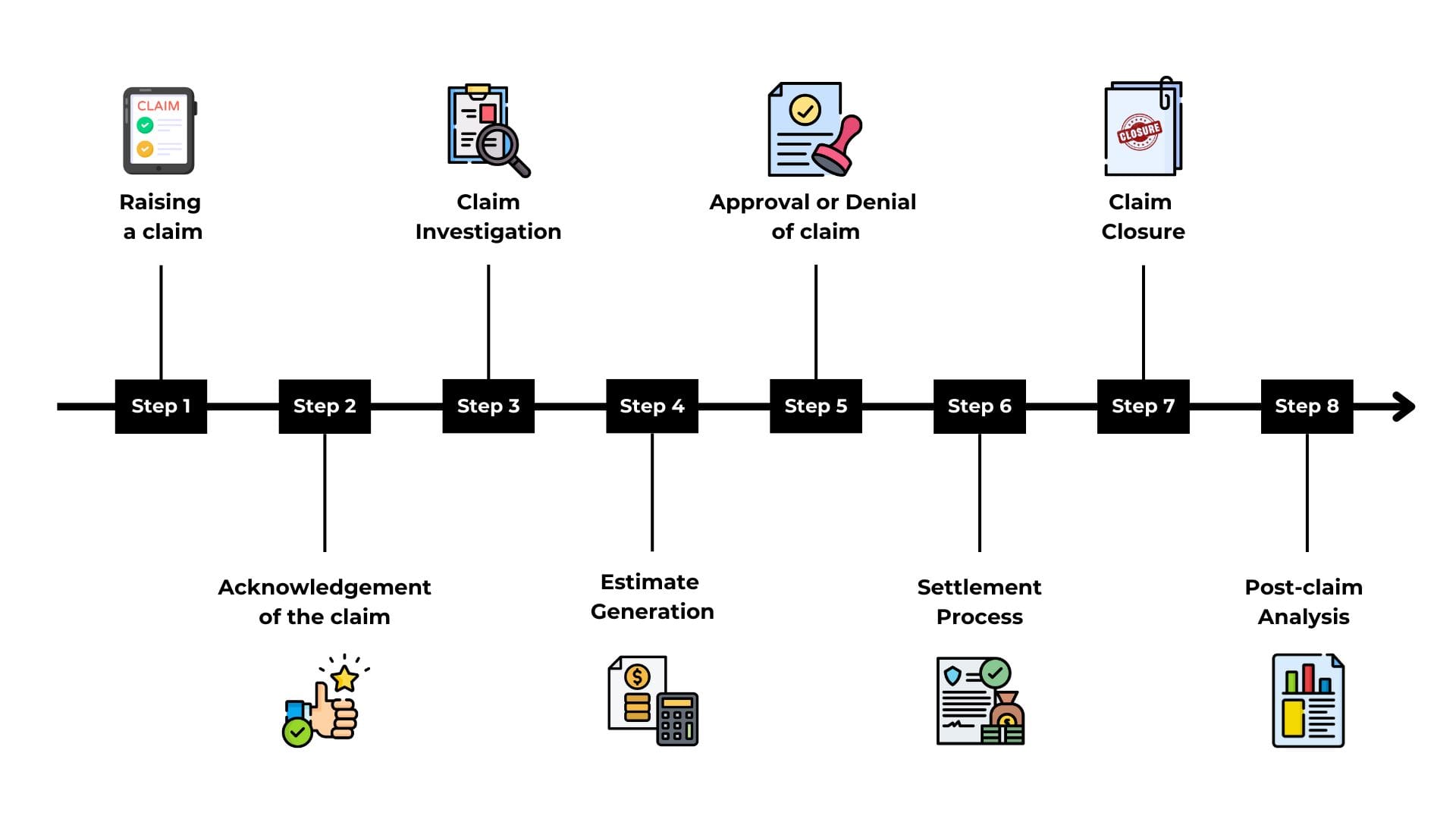
- Claim reporting - The policyholder submits details, photos, and relevant documentation.
AI auto-validates submission completeness at the point of receipt, removing the wait for a handler to open the file. - Acknowledgement - The insurer assigns a claim handler and issues a reference number.
AI acknowledges and categorises claims instantly, without a handler queuing the file. - Damage inspection - A field adjuster visits the vehicle or the customer is asked to send photos.
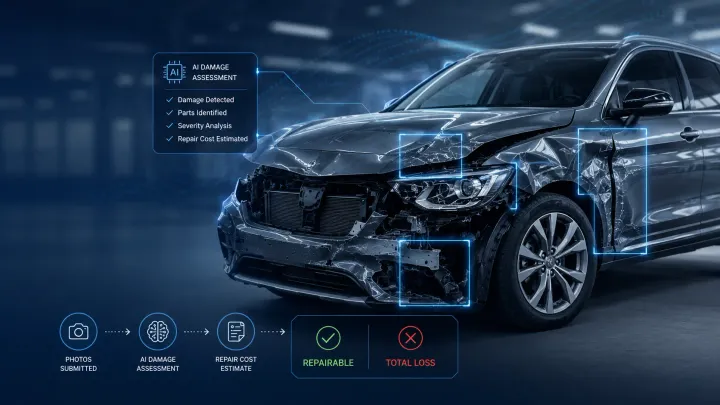
Today, AI-powered claim inspections replace much of this manual effort by analyzing customer-submitted photos and videos to generate a structured damage report in under two minutes. To understand how insurance claim inspections work and why they're evolving toward AI-driven workflows, read our complete guide - Motoe i - Fraud screening - Claims are reviewed manually for inconsistencies and fraud indicators.
AI completes pattern-based fraud checks in seconds, cross-referencing visual evidence against claim details. - Estimate generation - Damage repair costs are calculated against current market rates.
Automated claim estimation generates cost estimates and integrates with repair network pricing in real time. - Approval or denial - A handler reviews the claim file and issues a decision.
For qualifying claims, AI approves automatically against preset criteria with no manual review required. - Settlement and closure - Payment is initiated and final documentation is shared.
Automated settlement triggers payment within minutes of approval for STP-eligible claims. - Post-claim validation - Insurers log data to improve process and pricing.
How AI Transforms the Claims Journey
AI does not replace the claims process. It removes the waiting from each step by automating repetitive tasks, improving decision-making, and reducing manual intervention. This is one example of how claims technology is transforming the claims settlement process, allowing insurers to settle claims faster while improving operational efficiency.
- Automated claim validation checks the status of the policy, its coverage limits, and submission completeness as soon as the customer raises a claim. No handler needs to open the file first. Missing information triggers an immediate prompt for resubmission. This single step eliminates the 24 to 48 hour delay that often sits at the start of manual workflows.
- AI damage assessment replaces the field adjuster visit for visible surface damage. The policyholder submits photos or a short video via a guided smartphone flow. The AI identifies damage type and severity, and produces a structured condition report. Inspektlabs' model is trained on over 10 million real-world vehicle damage images, giving it the breadth to handle variation across vehicle types and markets.
- Fraud detection systems check for visual inconsistencies, flag damage patterns that do not match the report, and cross-reference claim history. Non-health insurance fraud costs US insurers more than $40 billion annually, according to FBI data cited by Capco. This can be reduced significantly by automated fraud detection during intake.
- Customer self-service gives the policyholder direct control. They submit claims, track status, and receive decisions through a digital interface without having to wait for a callback. This helps improve the overall customer experience, switching it from opaque and slow to transparent and fast.
AI Claim Estimation
Generate repair estimates in minutes, not days
Automate vehicle damage assessment to speed up claim decisions and reduce manual workloads.
How AI Decides Which Claims to Automate
Not every claim can be fully automated. AI-powered systems route claims based on three criteria assessed at intake.
Claim value. Low-value claims below a defined threshold are strong STP candidates. They carry limited financial risk and predictable damage profiles. Higher-value claims carry more uncertainty and are routed to fast-track or full manual review.
Damage type. Some damage types follow recognisable patterns that AI handles reliably. Glass damage, single-panel scratches, and minor bumper scuffs are clear examples. Complex multi-panel damage, structural issues, or damage that is not visible in photos requires human judgement.
Claim and customer history. First-time claimants with no prior fraud flags are low-risk profiles and, hence, are suited for STP. Repeat claimants, accounts with dispute history, or submissions where the incident details conflict with the visual evidence are automatically escalated.
This categorisation requires no human triage. The AI assesses all three criteria at submission and routes the claim to the correct workflow immediately. The right process starts without a queue.
Straight Through Processing (STP): Fully Automated Claims
STP is the fully automated end of the spectrum. A claim enters the system and exits as a settled payment with no human involved at any stage. Most insurers define STP thresholds based on claim value and risk tolerance.
What qualifies a claim for STP?
- Claim value is below the insurer's defined STP threshold
- Damage is limited to a single, clearly visible component
- No fraud flags or dispute history on the account
- Policy validity and coverage checks pass automatically
How STP works in practice
A policyholder with a cracked windscreen submits their claim through their insurer's app. They provide photos of the damage. The AI validates the policy, assesses the photo, classifies the damage as glass-only, and checks the claim value against the STP threshold. All criteria pass. The claim is approved automatically. Payment is initiated within minutes.
This is not a niche scenario. BCG estimates that fully automated simple claims could be resolved in real time for up to 70% of motor cases, cutting costs by 30 to 50%.
Limitations to acknowledge
STP does not cover ambiguous claims, incidents involving third parties, or cases where photo evidence is unclear. Those are escalated automatically. STP works precisely because it only handles claims where the evidence is unambiguous and the financial risk is contained. The right framing is: STP handles the predictable volume so your team can focus on the cases that genuinely need them.
Fast-Track Claims: AI-Assisted with Human Oversight
Fast-track claims sit between full automation and traditional manual review. AI handles the analysis. A human handler makes the final call.
What triggers fast-track routing?
- Claim value above the STP threshold but below the full manual review threshold
- Damage to multiple panels where AI assessment is confident but human sign-off is required by policy
- First-party claims with limited claim history where a human review adds assurance
- Submissions where one fraud check element returned an inconclusive result
The role of the human handler
In a fast-track workflow, the handler does not start from zero. By the time they open the file, the AI has completed the damage assessment, run the fraud check, generated the repair estimate, and flagged any anomalies. The handler reviews the output and approves or adjusts the decision. This takes minutes, not hours.
How smart triage works
Inspektlabs' triage model categorises incoming claims at the point of submission. It identifies which elements are AI-confident and which need human review. The handler opens a prioritised file with the key information already structured. They are verifying a recommendation, not conducting a full investigation.
This is the clearest practical difference between the two models. STP = AI-led, AI-confirmed. Fast-track = AI-led, human-confirmed.
STP vs Fast-Track Claims: Key Differences
How Inspektlabs Automates the Auto Insurance Claim Process
Inspektlabs provides the AI infrastructure that insurers, insurtechs, and motor claims platforms use to power both STP and fast-track workflows across the entire motor insurance claim process, from digital inspections and damage assessment to claim settlement.
Guided photo and video capture
Policyholders receive a link via SMS or app that guides them through photographing and filming the damaged vehicle from all required angles. No appointment, no field adjuster visit. For surface damage claims, this removes the biggest scheduling delay in the traditional process.
Automated photo quality check
Before the damage assessment begins, the system checks every submitted image for clarity, lighting, and coverage. Substandard images are rejected within 15 seconds, and the customer is prompted to resubmit. This quality gate ensures the assessment is based on usable evidence, not inadequate photos that create disputes later.
AI damage assessment and condition report
The model is trained on over 10 million vehicle damage images. It identifies damage type, location, and severity. A structured condition report is generated in approximately 90 seconds, documenting every flagged item with classification and estimated repair cost. This output drives the STP decision or populates the fast-track handler's file directly.
Fraud detection is built into the assessment
The AI cross-references reported incident details against the visual evidence, flags patterns inconsistent with the stated damage scenario, and highlights accounts with anomalous claim histories. These checks run as part of the assessment workflow, not as a separate review stage.
API integration with existing claims systems
Inspektlabs connects to existing claims management platforms via API. Insurers do not need to replace current systems. Photo capture, damage assessment, and report output plug into whatever workflow is already in place. The data is structured, timestamped, and retrievable for both STP routing and fast-track handler review.
Adopting AI for insurance claims automation is an operational decision that affects cost, customer satisfaction, and competitive position right now.
STP cuts low-complexity motor claims from days to minutes. Fast-track reduces moderate claims from days to hours. Together, they free experienced claims staff for the cases that genuinely need them. The result is faster payouts, lower operating costs, and a better experience for the policyholder at the moment that matters most.
Inspektlabs gives insurers the photo capture, damage assessment, and fraud detection infrastructure to deploy both models. If you are evaluating how AI for insurance claims automation fits your operation, contact us or book a demo and we will walk you through it.
Frequently Asked Questions
- What is automated claims processing in vehicle insurance?
Automated claims processing in vehicle insurance is the use of AI to automate key claim steps like validation, damage assessment, fraud detection, and settlement, reducing manual effort and speeding up resolution. - How does AI reduce insurance claims processing time?
AI removes the waiting steps: policy validation, damage assessment, and fraud checks all run in real time. AI-enabled carriers have cut average resolution time from 10 days to 36 hours. - What is STP (Straight Through Processing) in vehicle insurance?
STP is a fully automated claims workflow where low-complexity, low-value claims are assessed, approved, and settled without any human involvement. The policyholder submits photos, the AI validates and assesses the claim, and payment is triggered automatically if all criteria are met. - What is the difference between STP and fast-track claims?
STP is end-to-end automated with no human sign-off. Fast-track uses AI for all analytical work but routes the completed assessment to a human handler for final approval. STP suits simple, low-value claims. Fast-track suits moderate complexity claims where human oversight is needed. - Do insurance companies use AI to process claims?
Yes. Many insurance companies use AI to automate claims processing, including damage assessment, validation, fraud detection, and settlement decisions. Studies suggest AI adoption has significantly reduced claim processing times, in some cases from several days to under two days. - How can AI be used in claims processing?
AI is used for document validation, photo-based damage assessment, fraud pattern detection, repair cost estimation, claim routing, and settlement triggering. Each application removes a manual step from the workflow.