Human Vs. AI Vehicle Inspections: How Each Process Actually Works
Let's take a closer look at seven factors that will help us comprehend why these transformations will be revolutionary. We will contrast human inspections against AI inspections to grasp the true extent of these changes.
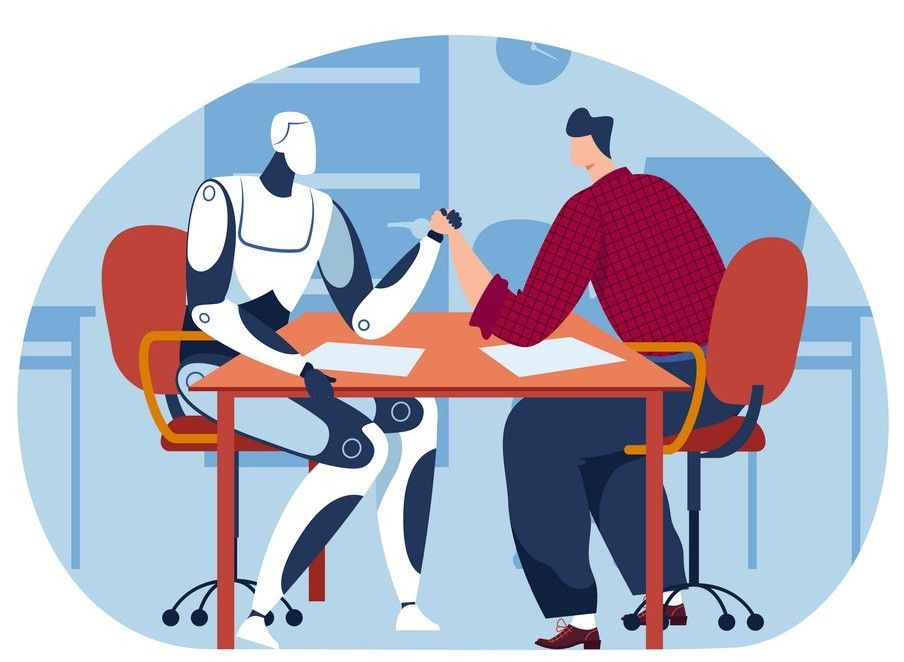
A human vehicle inspection is a sequential, inspector-driven process: one person arrives, walks around the vehicle, documents findings manually, and compiles a report. An AI-guided vehicle inspection is a guided capture and automated analysis process: the operator photographs the vehicle through a structured flow and the AI produces a structured condition report from that media.
Both produce a vehicle condition record. The process to get there is structurally different at every stage.
This article covers what each process looks like step by step, where the two approaches diverge structurally, a real-world example of both in action, and when each process is not the right choice. For a comparison of cost, speed, and accuracy outcomes rather than process steps, see the sibling guide linked at the end.
Human vs AI Vehicle Inspection: Side-by-Side Process Comparison
The table below maps the equivalent process steps for each approach, from initiation to report delivery.
What this table reveals is not just a difference in speed. It is a difference in where the process depends on human availability, coordination, and judgment. Each of those dependencies is a potential point of delay or inconsistency in the human process.
What Does a Human Vehicle Inspection Process Look Like?
A human inspection begins before the inspector arrives at the vehicle. The vehicle owner and the inspector need to agree on a time and location. That coordination step alone can add days to the process, particularly when the inspector has a full schedule, the vehicle is at a remote location, or the owner is only available outside standard business hours.
Once the inspector arrives, the walkaround process typically takes 30 minutes to several hours depending on the vehicle type, the extent of damage, and the depth of the inspection required. The inspector examines the exterior panel by panel, checks the glass, lights, tyres, and interior, and documents findings through photographs and manual notes.
Documentation quality varies. A large share of manually completed vehicle and claims forms contains errors, incomplete information, or unreadable data, and the same risk of inconsistency applies to manual inspection documentation. What one inspector records as a minor scratch, another may classify differently.
After the walkaround, the inspector compiles a report. This may happen on-site, but often happens later when the inspector processes their notes in the office. The report is then reviewed, formatted, and delivered. In a typical manual process, the total elapsed time from initial contact to completed report can run to two to five days.
The practical implication: a human inspection ties every part of the process to the availability and consistency of one person. That is manageable for individual cases. At scale, it becomes a structural bottleneck.
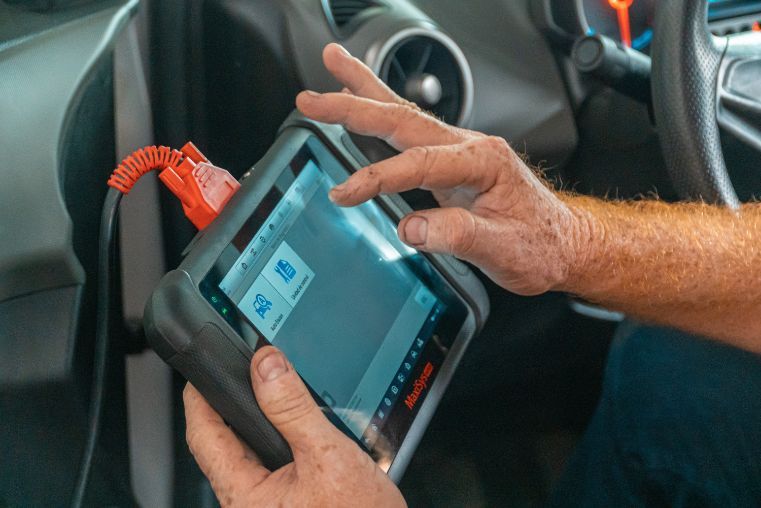
What Does an AI-Guided Vehicle Inspection Process Look Like?
An AI-guided inspection starts when a link is sent to the person responsible for capturing the vehicle. That might be the vehicle owner, a driver, a rental agent, or a fleet inspector. No appointment is needed. The capture can happen immediately after an incident, at a shift handover, or at any point the operator chooses.
The person opens the guided capture flow on their smartphone. The app prompts them through the required capture sequence: exterior panels from set angles, glass components, lights, tyres, and any specific areas defined by the inspection type. The guidance removes the judgment calls that cause inconsistency in manual capture. Both someone doing their first vehicle inspection and someone who has done hundreds will follow the same sequence.
Before the AI assessment runs, an automated quality check validates every submitted image. Images that are blurred, underexposed, or taken from the wrong distance are rejected within seconds, and the user is prompted to retake them. This quality gate is what makes AI-powered damage detection reliable across submissions from different people in different conditions.
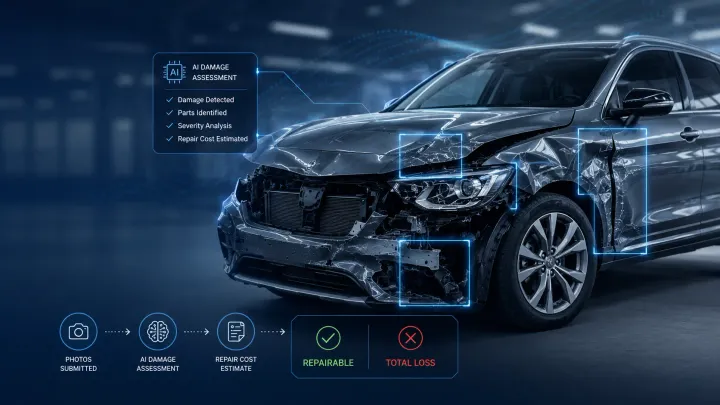
The AI model then processes all submitted media simultaneously. It identifies damage across all major vehicle components, classifies each finding by type and severity, and generates a structured condition report. The report is ready within minutes of the upload completing.
The practical implication: an AI inspection process has no scheduling dependency, no travel component, and no documentation step that relies on individual judgment. The result is a consistent report regardless of who conducted the capture, where the vehicle was, or what time it was.
The limitation to acknowledge: AI inspection covers visible damage from the submitted media. Mechanical damage, internal component condition, and damage not captured due to image quality limitations fall outside what the process can assess from photos and video alone.
See Accuracy Benchmarks
See how AI detects even micro vehicle damages
Understand how AI inspection accuracy improves over time
Where Do the Two Processes Diverge Most?
The step-by-step process comparison shows what happens at each stage. The structural table below shows what kind of system each approach is.
For a detailed breakdown of how these structural differences translate into cost, accuracy, and scalability outcomes, see cost, speed, and accuracy compared on the sibling page.
A Real Example: Inspecting a Damaged Rental Car After Return
The following is a hypothetical scenario illustrating how each process plays out in a common fleet and rental context.
The human inspection flow
A rental car is returned to a depot at 6pm. The vehicle has visible damage on the front bumper. The return agent notes the damage on a paper form and flags it for inspection.
An inspector is available the next morning. They arrive, conduct a 25-minute walkaround, photograph the damage, check the rest of the vehicle, and compile notes. The written report is completed later that morning. The customer has already left. If the customer disputes the charge, the dispute rests on a report written 12 to 18 hours after the vehicle was returned, based on one inspector's notes.
The AI inspection flow
The same car is returned at 6pm. The rental agent uses the guided capture app to photograph the vehicle at the point of return. The process takes four minutes. The AI generates a condition report with the damage classified, located, and documented, within two minutes of the upload completing.
The customer is still present. If they dispute the charge, both the agent and the customer can review the same timestamped report before the customer leaves. The evidence exists from the moment of return, not from a later visit.
The difference is not just process time. It is the point in the transaction at which verifiable documentation exists, and who has access to it when the decision matters most.
When Does Each Inspection Process Break Down?
Every inspection process has conditions under which it is not the right choice.
When human inspection is not the right choice
- Volume is too high for available inspector capacity. Scheduling and travel time set a ceiling on how many inspections can be completed per day.
- Geographic distribution makes travel impractical. A vehicle in a remote location, or across a large network of sites, requires inspector deployment that may not be operationally viable.
- Consistency across many inspectors is required. When multiple inspectors are used, the documentation standard varies. There is no mechanism to apply identical criteria across all submissions.
- The situation requires immediate documentation. A vehicle returned after hours, or an incident requiring real-time evidence, cannot wait for an inspector to become available.
When AI inspection is not the right choice
- Mechanical or internal damage needs to be assessed. AI inspection covers visible surface damage from photos and video. Engine condition, brake systems, and internal component failure require physical access and specialist diagnostic tools.
- Image quality is insufficient. Inspection in very low light, heavy rain, or extreme glare can produce media that falls below the quality threshold. The quality gate will reject and re-prompt, but in some environments the required quality cannot be achieved.
- The damage requires physical interaction to assess. Some structural deformation is only apparent when pressure is applied, or when panels are removed. Photo-based AI cannot replicate physical inspection for these cases.
- Edge cases require specialist knowledge. Vehicles with unusual configurations, significant prior repairs, or damage types that fall outside the training distribution may require human review to interpret correctly.
What Are the Alternatives to a Fully Manual Inspection Process?
Manual inspection is not a binary choice. Three distinct alternatives exist, each suited to a different operational context.
AI-guided smartphone capture
The person responsible for the vehicle uses a guided app to capture it from required angles. The AI processes the media and generates a condition report. This model has no infrastructure requirement beyond a smartphone with internet access.
It is suited to: distributed fleets, rental returns at varied locations, insurance pre-inspections where the policyholder submits remotely, and any scenario where the vehicle cannot practically go to a fixed inspection point. The limitation is that it depends on the user following the guided capture sequence and the submitted media meeting quality requirements.
Fixed-camera scanning systems
A vehicle drives through a scanning bay equipped with multiple cameras. The cameras capture the vehicle from all required angles automatically. The AI processes the images and generates a report without any user input beyond driving through the bay.
This model is suited to: high-volume depot environments where vehicles pass through a controlled entry or exit point, airport rental depots, fleet yards, and auction centres. It removes the user variability entirely but requires installation of fixed infrastructure at the inspection location.
Hybrid inspection: AI-first with human review for flagged cases
AI processes all submissions. Cases that pass all quality and assessment checks move through automatically. Cases flagged by the AI due to image quality issues, damage complexity, suspected fraud, or high-value vehicles are routed to a human reviewer.
This model is suited to: insurance claims workflows, fleet management operations, and rental companies where most cases are routine but a minority require specialist judgment. The human reviewer sees a pre-analysed file with the AI's findings and flags, not a blank inspection form. The review is faster and more consistent than a fully manual process.
This is the model that applies to most B2B operations at scale. AI handles the repeatable, high-volume work. Human expertise is applied to the cases where it genuinely matters.
Key Takeaways
- Human inspection is sequential and inspector-driven. AI inspection is guided capture with automated analysis. The structural difference affects every step from scheduling to report delivery.
- The human process depends on individual availability, travel, and consistent documentation. AI inspection removes each of those dependencies.
- AI inspection covers visible surface damage from photos and video. Mechanical damage, internal faults, and edge cases beyond the training distribution still require human assessment.
- The rental car example shows the most practical difference: verifiable documentation exists at the moment of return with AI, not hours or days later.
- Three alternatives to fully manual inspection exist: AI-guided smartphone capture, fixed-camera scanning systems, and hybrid models with AI-first plus human review for flagged cases.
- For the cost, speed, and accuracy comparison between the two approaches, see the dedicated comparison guide.
Human and AI vehicle inspections both produce a condition record. The process to get there is structurally different in ways that matter for scheduling, consistency, documentation, and scale.
Understanding the process is the first step in deciding which approach fits a given operation. For most high-volume, distributed, or remote use cases, AI-guided inspection addresses the structural limitations of the manual process. For complex, mechanical, or high-value assessments, human expertise remains necessary.
Inspektlabs supports all three deployment models: smartphone app, fixed camera scanner, and hybrid workflows. See AI-powered damage detection for how the platform works in practice.
Frequently Asked Questions
What are the steps in a human vehicle inspection?
A human inspection follows six steps, scheduling, travel, walkaround documentation, report compilation, review, and delivery. Each step depends on inspector availability and coordination with the vehicle owner.
What are the steps in an AI-guided vehicle inspection?
An AI inspection follows four steps, receiving a capture link, guided photo and video capture, automated quality validation and processing, and report generation. No travel or scheduling is required.
Is AI inspection faster than human inspection?
In process terms, AI inspection completes its core stages, from capture to report, within minutes. A human inspection from initiation to completed report typically takes hours to days, depending on scheduling, travel, and documentation time. For a detailed comparison of how this translates to operational outcomes, see the sibling comparison guide.
What are the alternatives to manual vehicle inspection?
Three alternatives exist. AI-guided smartphone capture replaces the inspector with a guided app and automated analysis. Fixed-camera scanning systems automate capture for high-volume fixed-site operations. Hybrid models use AI for all submissions and route flagged cases to human reviewers. Each suits a different operational context.
Do human and AI inspections check the same things?
Both cover visible exterior damage: panels, glass, lights, tyres, and interior surfaces. Human inspections can also assess mechanical condition, engine components, and internal damage through physical access. AI inspection is limited to what is visible in the submitted photos and video. For internal damage prediction from external indicators, see the methodology documentation.
Can AI and human inspection processes work together?
Yes. The hybrid model is specifically designed for this. AI processes all submissions and flags cases that require specialist review. A human reviewer then assesses the flagged cases using the AI's pre-structured findings. The combined process is more consistent than purely manual review and more capable than AI alone for complex cases.
What is the best inspection process for vehicle assessment?
There is no single best process. AI-guided inspection is suited to high-volume, distributed, or remote operations where scheduling and consistency are the primary challenges. Human inspection is suited to mechanical assessment, complex damage, and edge cases that require physical access or specialist judgment. Hybrid models address both simultaneously.