
Total Loss vs Repairable: How Insurers Decide and How AI Improves Claim Decisions
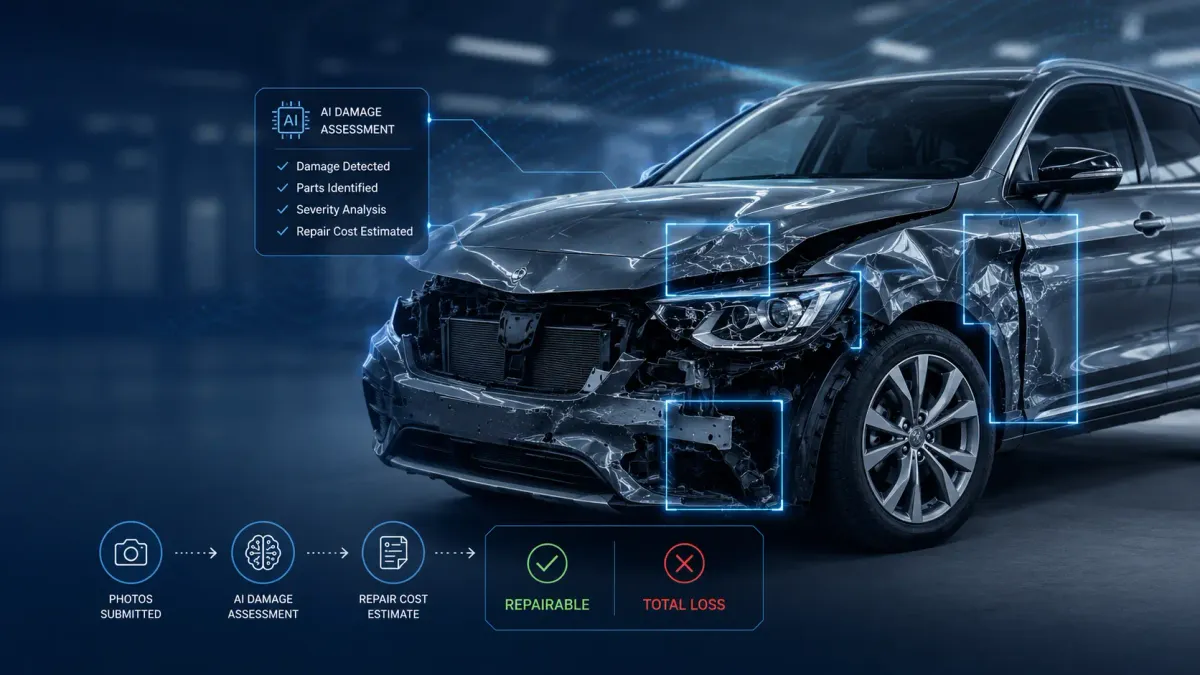
Every motor insurance claim eventually reaches the same decision: repair the vehicle or declare it a total loss. That decision determines what the insurer pays, how long the claim takes, and whether the policyholder is satisfied with the outcome.
It is also the point where the claims experience most often breaks down. The J.D. Power 2025 U.S. Auto claims satisfaction study found that satisfaction scores fell 9 points among consumers who experienced a total loss, with only 58% saying the total loss valuation fully met their expectations. More than four in ten policyholders who are written off do not accept the number they are given.
This gap stems from a direct operational problem. A dispute with the valuation extends the time taken for the claim to be processed, consumes the adjuster’s time, and damages the policyholder-insurer relationship. While the decision itself may be correct, it’ll still feel suspicious if the evidence behind it is not clear.
This article covers how the total loss decision is actually made, what goes into each side of the calculation, and where AI vehicle inspection software now fits into the process.
In Short
- Total loss occurs when repair costs exceed a predefined threshold.
- Most insurers compare repair cost with Actual Cash Value (ACV).
- AI speeds up damage assessment and improves decision consistency.
- FNOL automation reduces claim cycle time.
Total Loss by the Numbers
Understanding the numbers behind a total loss decision helps explain why the same vehicle may be repairable in one market but a total loss in another. The table below summarizes key insurance metrics, including Actual Cash Value (ACV) thresholds, Total Loss Formula adoption, and consumer settlement trends.
What is a Total Loss Vehicle?
A total loss vehicle is one where repairing it no longer makes economic sense relative to what the vehicle is worth. The decision is based on the repair cost, the vehicle's actual cash value (ACV), and the applicable total loss threshold. It is a financial judgment, not a statement about whether the vehicle is physically repairable.
Most written-off vehicles could technically be repaired. The question is whether the cost of doing so exceeds what the insurer would pay to simply settle the vehicle’s value and dispose of the wreck. When it does, the vehicle is declared a total loss.
Total loss, Repairable, and Salvage: How the terms relate?
Repairable loss: The estimated cost of repair falls below the insurer’s threshold relative to the vehicle’s value. The insurer authorises repair and the vehicle returns to the road.
Total loss: This happens when the estimated repair cost meets or exceeds the threshold. The insurer settles the vehicle’s pre-accident value with the policyholder rather than paying for repair.
Salvage: What remains of the vehicle after it is written off. The insurer typically takes ownership of the damaged vehicle and recovers value by selling it, either for parts or to a rebuilder. That recovery reduces the net cost of the claim.
A total loss vehicle in one market may be considered repairable in another. There is no global standard dictating thresholds, valuation methods, and regulatory rules. These usually differ based on rules set by the jurisdiction and the insurer.
Repairable vs Total Loss
Most damaged vehicles fall into one of two categories: repairable or total loss. The difference depends on whether the estimated repair cost remains below or exceeds the applicable total loss threshold. The comparison below highlights the key differences between the two outcomes.
What is the Total Loss Threshold?
The basic test for a Total Loss Threshold is a ratio - Estimated repair cost divided by the vehicle’s pre-accident value, expressed as a percentage. When that percentage crosses a defined threshold, the vehicle is written off.
The total loss ratio
The total loss ratio compares the estimated repair cost with the vehicle's Actual Cash Value (ACV). It is calculated as:
Total Loss Ratio = Estimated Repair Cost ÷ Actual Cash Value (ACV)
Example: A vehicle with an Actual Cash Value (ACV) of $20,000 and an estimated repair cost of $15,000 has a total loss ratio of 75%.
If the applicable total loss threshold is 75%, the vehicle is declared a total loss. If the threshold is 80%, the same vehicle remains repairable
Why is the Total Loss Threshold Usually 75%?
In the United States, 75% is the most frequently applied threshold. Around fifteen states apply a 75% total loss threshold, including New York, Massachusetts, and North Carolina. But the actual range across US states runs from 60% in Oklahoma to 100% in Texas. Florida, Mississippi, and Oregon sit at 80%.
Roughly half of US states do not set a statutory threshold at all. Those states apply the Total Loss formula instead, which asks whether repair cost plus salvage value exceeds the vehicle’s actual cash value. California, Georgia, Illinois, and Pennsylvania are among the states using this approach. Where no statutory rules exist, insurers set their own threshold, typically in the 70% to 80% range.
Outside the US, the picture varies again. UK insurers use a category system (Cat A, B, S, N) that classifies write-offs by the nature and severity of damage rather than by a single cost ratio. European markets apply their own conventions. Any AI system supporting this decision has to be configured to the rules that apply in the market it serves.
How Actual Cash Value (ACV) Affects Total Loss Decisions?
The repair cost is only half the equation. The value side is more complex than a single market price.
Market value vs Agreed value: Most policies settle at actual cash value, the vehicle’s market value immediately before the incident, accounting for age, mileage, condition, and specification. Some policies, particularly for classic or high-value vehicles, use an agreed value fixed at policy inception. The two can differ significantly.
Salvage recovery: The insurer typically recovers value by selling the damaged vehicle. That expected recovery is netted off the cost of the write-off. A high salvage value makes writing the vehicle off less expensive and therefore more likely.
Incidental costs: Towing, storage while the claim is assessed, and any rental or loss-of-use provision all add to the cost of a repairable claim. A long repair time increases these costs. When repair is borderline, high incidental costs can tip the decision towards a write-off.
How Insurers Decide if a Vehicle is a Total Loss: Step-by-Step Process
From First Notice of Loss (FNOL) to the final settlement decision, insurers follow a structured five-step process to determine whether a vehicle should be repaired or declared a total loss.
- Capture at First Notice of Loss: The policyholder or a field assessor documents the damage with photos and videos. In a manual workflow, this may mean waiting days for an adjuster visit. With FNOL automation, the policyholder captures the vehicle through a guided app flow at the point of incident, and the media is validated for quality before it enters the assessment.
- Damage assessment: Each affected component is identified, classified by damage type, and assessed for severity. For each damaged part, the assessment determines whether it can be repaired or requires replacement. This part-by-part decision is what the repair estimate is built from.
- Repair estimate: Repair estimates include labour hours calculated per operation, priced at the applicable market rate. Parts are priced at OEM or aftermarket rates depending on the policy and the vehicle’s age. Paint, materials, and any calibration requirements are added. It all adds up to make the final repair estimate.
- Comparison against adjusted vehicle value: The estimate is compared against the vehicle’s actual cash value, adjusted for expected salvage recovery and incidental costs. The resulting ratio is tested against the applicable threshold.
- Routing: If the ratio falls below the threshold, the claim routes to a repair pathway and a body shop assignment. If it meets or exceeds the threshold, the claim routes to total loss processing, valuation confirmation, and salvage disposal.
The biggest opportunity to reduce claim cycle time is at the first step. In a manual process, several days can pass between the incident and the initial damage assessment. With AI vehicle inspection software processing photos submitted during First Notice of Loss (FNOL), damage assessment, repair estimation, and claim routing can begin within minutes.
Why Repair Estimates Determine Total Loss Decisions?
The write-off call is only as good as the estimate underneath it. If the estimate is wrong, the decision is wrong, regardless of how correctly the threshold is applied.
An overstated estimate will write off a vehicle that should have been repaired. In this case, the insurer pays the full vehicle value instead of the repair cost, and the policyholder loses a vehicle that could have returned to the road. An understated estimate sends a vehicle to a body shop that will discover additional damage mid-repair, generating supplements, extending cycle time, and often arriving at a write-off anyway after repair costs have already been incurred.
How Pre-existing Damage Affects Total Loss Decisions?
The most common source of estimate error is recording pre-existing damage as accident-related. A vehicle presented for a claim often carries damage older than the reported incident: Old scratches, a dent from the previous car park impact, curbed alloys, a cracked mirror housing, etc.
If this pre-existing damage is included in the repair estimate, the estimate inflates. On a borderline claim, that inflated estimate can push the ratio over the threshold resulting in a write-off that should not have happened. On an older, lower-value vehicle, where the threshold is easier to reach in absolute terms, the effect is more pronounced.
How AI Separates Accident Damage from Pre-existing Damage?
Four methods separate new damage from pre-existing damage.
- Rust and ageing patterns: Fresh metal damage exposes bare metal or primer that has not yet oxidised. Older damage shows rust formation at the edges, paint fading around the affected area, and dirt accumulation within the deformation. These are visually identifiable indicators of damage age.
- Damage consistency with a single incident: A single impact produces a coherent damage pattern. Force travels through the vehicle structure in a predictable way. Damage on opposite sides of a vehicle, or damage inconsistent with a single point of impact, indicates multiple separate events.
- Cross-checking against the accident description: The stated cause of the incident should match the physical evidence. A reported rear-end collision that produces front bumper damage requires explanation. Cross-referencing the damage pattern against the FNOL narrative identifies these inconsistencies.
- Comparison against prior claim history: If the vehicle has a prior claim record, the damage documented in that claim can be compared against the current submission. Damage that appeared in an earlier assessment and was settled but not repaired should not be counted again.
This is also where fraud detection and estimate accuracy overlap. The same analysis that isolates prior damage for estimate accuracy also identifies deliberate attempts to include pre-existing damage in a claim. See fraud detection built into the inspection process for how this works in practice.
Why Total Loss Decisions Go Wrong in Insurance Claims?
Even when insurers follow the correct threshold, the outcome depends on the quality of the underlying estimate. Some of the most common causes of incorrect total loss decisions include:
- Pre-existing damage being included in the repair estimate.
- Hidden structural damage identified only after dismantling.
- Incorrect labour rates or parts pricing.
- Vehicle valuations that do not reflect current market conditions.
- Salvage recovery estimates that are either too high or too low.
Most of these issues originate before the threshold is applied. Improving damage assessment accuracy reduces unnecessary write-offs as well as repair supplements later in the claim.
How AI Improves Total Loss Decisions?
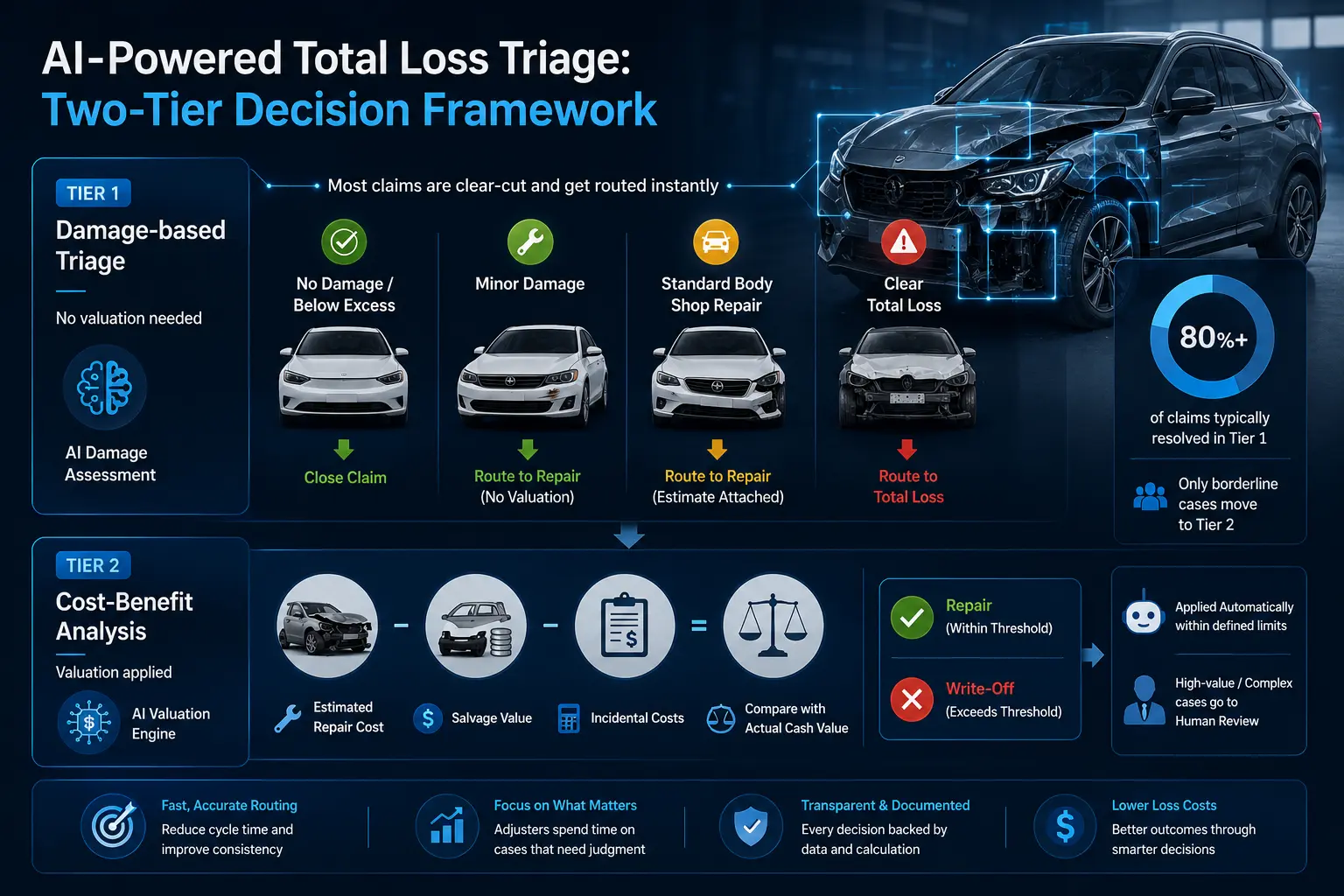
AI improves total loss decisions by identifying damaged components, estimating repair costs, and routing claims before a full valuation is required. Most claims can be resolved through damage assessment alone, while only borderline cases require a detailed valuation. A two-tier model reflects this approach.
Tier 1: AI Damage Assessment and Claim Triage
Most claims fall clearly on one side of the line. A vehicle with a scuffed bumper and a cracked indicator lens is not a total loss candidate under any threshold. A vehicle with structural deformity across multiple panels and a deployed airbag system is unlikely to be repairable economically on an older vehicle.
Tier 1 triage sorts claims into clear buckets based on damage assessment alone. At this stage, AI identifies whether a vehicle is likely to be repaired, requires further review, or should proceed directly to the total loss workflow.
- No damage or damage below the policy excess: Closed without further processing.
- Minor damage: Routed directly to repair. No valuation required.
- Standard body shop repair: Routed to a repair pathway with the repair estimate attached.
- Clear total loss: Severe structural damage on a vehicle where repair is clearly uneconomic. Routed directly to total loss processing.
Only cases that fall near the threshold escalate to Tier 2. In practice, this covers the large majority of claim volume. The specific proportion varies by portfolio, vehicle age mix, and market, but the operational principle holds: Most claims do not require a valuation exercise to route correctly.
Tier 2: AI Valuation and Total Loss Decision
The remaining claims are genuinely borderline. These require the full calculation.
In this tier, the repair cost is compared against actual cash value, net of expected salvage recovery and the incidental costs the claim would incur if repaired. The applicable threshold for the market and policy is applied. The output is repair-or-write-off recommendation with the underlying numbers documented.
The next step is usually a design choice for the insurer. The recommendation can be applied automatically for claims within defined parameters, or routed to a human adjuster for confirmation. Most carriers apply automation to a defined value band and route higher-value or more complex cases to human review. The AI produces the evidence and the calculation. The adjuster makes the call on the cases that warrant it.
AI is valuable because it improves consistency rather than replacing established claims practices. Every vehicle is assessed using the same inspection criteria, reducing variation between adjusters and improving estimate quality. Earlier damage assessment also allows insurers to identify likely repairable vehicles, potential total losses, and claims requiring additional review much sooner in the claims lifecycle.
For insurers handling large claim volumes, this translates into faster claim routing, fewer manual inspections, and more consistent repair estimates without changing the underlying total loss rules.
Inspektlabs
Make Total Loss Decisions Faster with AI Vehicle Inspection
See how AI-powered damage assessment helps insurers generate accurate repair estimates, identify repairable and total loss vehicles earlier, and accelerate First Notice of Loss (FNOL) workflows.
Why Local Market Calibration Matters for AI Vehicle Inspection?
A dent on a rear quarter panel looks the same in Manchester, Munich, and Mumbai. What that dent costs to repair, and what the resulting ratio means for the write-off decision, does not.
Three variables differ by market.
Thresholds: As covered above, the threshold ranges from 60% to 100% across US states alone, and other markets use entirely different classification systems. A model calibrated to a 75% threshold produces wrong answers in a 100% threshold market.
Labour rates and part pricing: Body shop labour rates vary significantly between markets and within them. Parts availability and pricing differ by region and by vehicle. The same repair operation carries different costs depending on where it is performed.
Vehicle values: Used vehicle markets are local. The same model and year carries different market value across regions, which changes the denominator in the ratio calculation.
This is why historical claim outcomes matter for model calibration. Feeding an AI system the actual repair-or-write-off decisions a carrier has made, along with the damage assessments and estimates that produced them, tunes the model to that carrier’s real-world decision boundaries. A model calibrated on generic industry data produces recommendations that do not match how the carrier actually operates.
Benefits of Automating the Total Loss Decision
- Faster, more consistent triage at First Notice: When damage assessment runs on FNOL photos, the repair-or-write-off signal is available within minutes of the policyholder reporting the incident. That removes days of waiting for an adjuster inspection before the claim can be routed.
- Fewer disputes through defensible estimates: An estimate built from documented, timestamped damage evidence, with each finding classified and priced, is easier to defend than one built from an adjuster’s written notes. When a policyholder disputes a write-off decision, the evidence base is available and specific.
- Reduced leakage from missed or over-counted damage: Both directions of estimate error cost money. Damage missed in the initial assessment produces supplements and extended cycle times. Pre-existing damage counted as accident-related produces unnecessary write-offs. Systemic assessments reduce both.
The earlier the decision is made accurately, the more of the downstream cost is avoided. This is the practical case for connecting damage assessment to the FNOL stage rather than treating it as a separate step. See how FNOL automation works for the full intake workflow.
How Different Industries Use AI for Total Loss Decisions?
Although total loss decisions follow the same principles across the insurance industry, the operational benefits vary by business type. AI-powered vehicle damage assessment helps insurers and fleet operators make faster, more consistent decisions while reducing manual effort.
Insurance carriers use automated damage assessment to accelerate First Notice of Loss (FNOL), improve estimate consistency, and reduce claim leakage.
Fleet operators can quickly determine whether damaged vehicles should be repaired, replaced, or removed from service, reducing operational downtime.
Vehicle rental companies benefit from faster vehicle inspections between rentals, allowing damage assessments to begin immediately after vehicle return.
Leasing and automotive finance companies use consistent vehicle condition assessments to support end-of-lease inspections and residual value decisions.
Regardless of the industry, every total loss decision depends on three key factors:
- An accurate repair estimate based on accident-related damage.
- A vehicle valuation that accounts for Actual Cash Value (ACV), salvage value, and associated claim costs.
- The applicable total loss threshold or Total Loss Formula for the insurer's market.
Get any of the three wrong and the decision is wrong, however sound the process looks. Estimate errors are the most common failure point, and pre-existing damage is the most common cause of estimate error.
AI does not change how a total loss decision is made. It changes how quickly and consistently that decision can be made. By assessing vehicle damage at First Notice of Loss (FNOL), AI helps insurers generate repair estimates earlier, identify likely total loss vehicles sooner, and support every decision with documented evidence.
Bringing Total Loss Decisions Closer to First Notice Of Loss
The earlier insurers can identify whether a vehicle is repairable or likely to be written off, the sooner the claim can move to the appropriate workflow. AI vehicle inspection software makes that possible by generating consistent repair estimates from photos captured during First Notice of Loss (FNOL), helping insurers route claims faster while reducing unnecessary manual inspections.
If you're looking to modernise your vehicle inspection process, see how Inspektlabs combines AI vehicle inspection, damage detection, and claims automation to support faster, evidence-based total loss decisions.
Frequently asked questions
What percentage makes a car a total loss?
In the United States, 75% is the most common threshold, meaning a vehicle is written off when repair costs reach 75% of its actual cash value. The actual range runs from 60% in Oklahoma to 100% in Texas.
Who decides whether a car is a total loss - The insurer or the assessor?
The insurer makes the decision based on the assessment carried out by the field adjustor, an independent appraiser, or an automated assessment system. In states with a statutory threshold, the insurer must apply that threshold. Where no statutory rule applies, the insurer’s own policy threshold governs.
What is Salvage Value?
Salvage value is the estimated amount an insurer can recover by selling a vehicle after it has been declared a total loss. The damaged vehicle may be sold for parts, scrap, or rebuilding, depending on its condition and local regulations. Salvage value is an important factor in total loss calculations because it reduces the insurer's overall claim cost and can influence whether a vehicle is repaired or written off.
What is Actual Cash Value (ACV)?
Actual Cash Value (ACV) is the estimated market value of a vehicle immediately before an accident, taking into account depreciation. Insurers calculate ACV using factors such as the vehicle's age, mileage, condition, specification, and local market prices. ACV is used to compare the estimated repair cost against the vehicle's value when determining whether it should be repaired or declared a total loss.
Can a repairable car still be written off, and vice versa?
Yes to both. Most written-off vehicles are physically repairable but are written off because the repair is uneconomic. Conversely, a vehicle with severe-looking damage may be repaired if its value is high enough that repair costs stay below the threshold.
Can hidden damage change a total loss decision?
Yes. Hidden damage discovered after a vehicle is dismantled can significantly increase the repair estimate. If the revised repair cost pushes the vehicle above the applicable total loss threshold or Total Loss Formula, a vehicle that was initially considered repairable may later be declared a total loss. This is why accurate damage assessment at the start of the claims process is critical.
How does AI reduce the total loss claim cycle time?
AI shortens the total loss claim cycle by assessing vehicle damage as soon as photos are submitted during First Notice of Loss (FNOL). Instead of waiting for a manual inspection, AI identifies damaged components, estimates repair costs, and flags likely total loss vehicles within minutes. This enables insurers to route claims to the appropriate repair or total loss workflow sooner, reducing manual inspections, improving estimate consistency, and accelerating claim settlement.