Fleet Health Score: How to Measure and Improve It
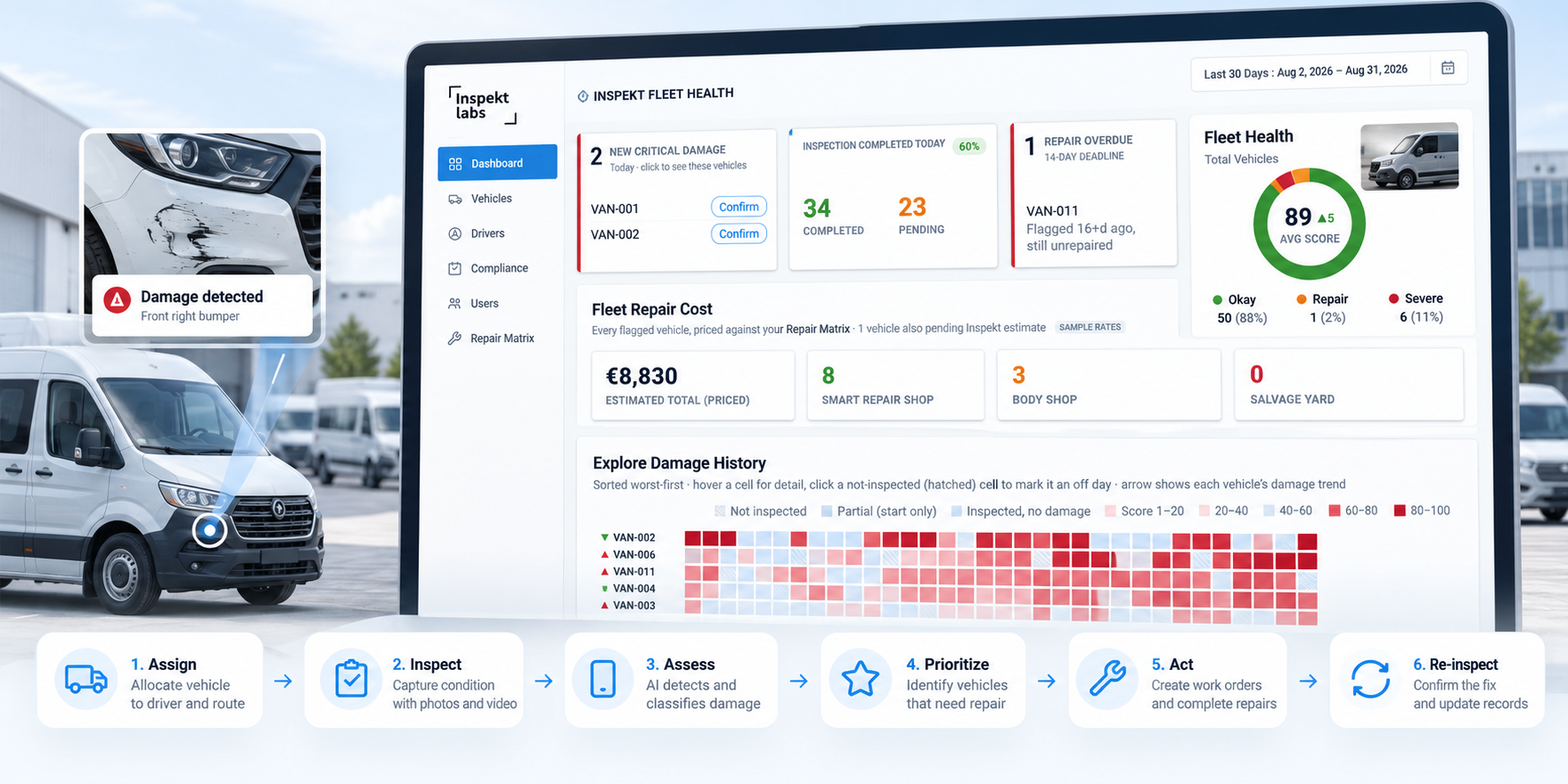
As a fleet grows, keeping track of vehicle condition becomes more difficult. There may be inspection reports to review, defects to follow up on, and repairs still in progress. What matters to a fleet manager is being able to quickly see which vehicles need attention and why.
Some vehicles are ready to go. Others need a repair before they can return to service, while a few may need to be taken off the road. When inspection and repair information is spread across different records, it becomes easier to miss a recurring defect, overlook new damage, or leave a repair open for too long.
This is where inspection data becomes important. A fleet running regular inspections can generate a large amount of vehicle-condition data over time. Most inspections may show no significant issue, but the vehicles with new or serious problems need to stand out quickly.
A fleet health score provides a way to bring this information together at the fleet level. The fleet health dashboard adds the operational context, helping managers see the overall condition of the fleet, identify vehicles that need attention, and drill into the inspection and damage information behind the score.
What Is a Fleet Health Score?
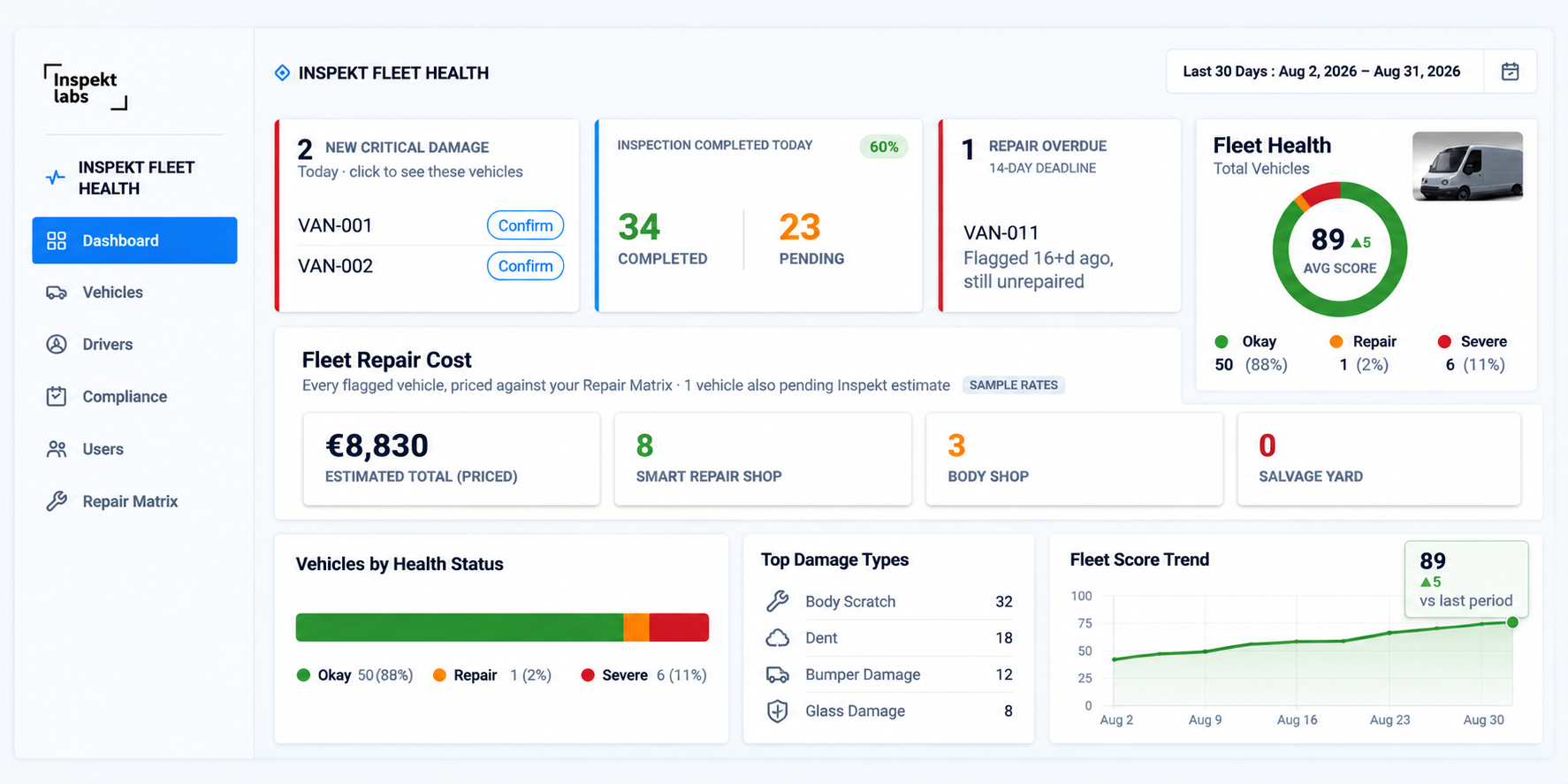
A fleet health score is a composite indicator that summarizes the condition of vehicles across a fleet using data such as inspection findings, damage, repair status, and inspection recency. It gives fleet managers a quick way to identify where attention may be needed, while the underlying inspection data provides the detail needed to investigate individual vehicles.
Scoring methods vary by platform and fleet. Some use a 0–100 scale, while the factors and weighting can differ based on vehicle type, operating environment, and fleet objectives. The usefulness of the score therefore depends on the quality and recency of the data behind it.
Fleet health and fleet health score are related, but they are different things.
- Fleet health is the real condition of your vehicles across inspections, damage, and maintenance.
- A fleet health score puts that condition into a single indicator, making a large fleet easier to assess at a glance.
How the fleet health score is calculated depends on the vehicle type, the operating environment, and what the fleet or software provider chooses to weight.
Why Do Fleet Managers Need a Fleet Health Score?
The core problem a fleet health score is designed to solve is not collecting inspections. It is reading them together. A structured pre-trip program, like the one covered in our pre-trip inspection checklist for fleets, gives every vehicle its own record. A manager with 10 vehicles can hold those records in memory and a spreadsheet. A manager with 200 or 2,000 cannot, because each vehicle also carries open repairs, earlier damage, and a status that changes after every inspection. Nobody can read all of that by hand and say which vehicles need attention first.
Without some way to combine them, a few things tend to happen. Recurring defects on the same vehicle go unnoticed because the reports sit in separate records. Severe new damage looks no different from a cosmetic issue. Overdue repairs get buried. And the manager spends the day hunting instead of acting.
There is a compliance side and a cost side to this. Under the federal DVIR rule, a carrier must repair any reported defect likely to affect safe operation before the vehicle runs again, and it must keep the report and repair certification for three months. On cost, ATRI found that repair and maintenance costs rose 8.6% in 2025, one of the fastest-rising line items in trucking. Planned, timely repairs matter more when costs climb like that.
What Can Influence a Fleet Health Score?
No fixed industry formula exists for the fleet health score. Platforms pull in data from vehicle systems, maintenance and inspections, and fleet performance indicators, then combine it into a single number. These are the inputs that most often shape the result:
A platform may weight these differently, and some add inputs specific to a fleet's operations, such as vehicle age, mileage, or usage type.
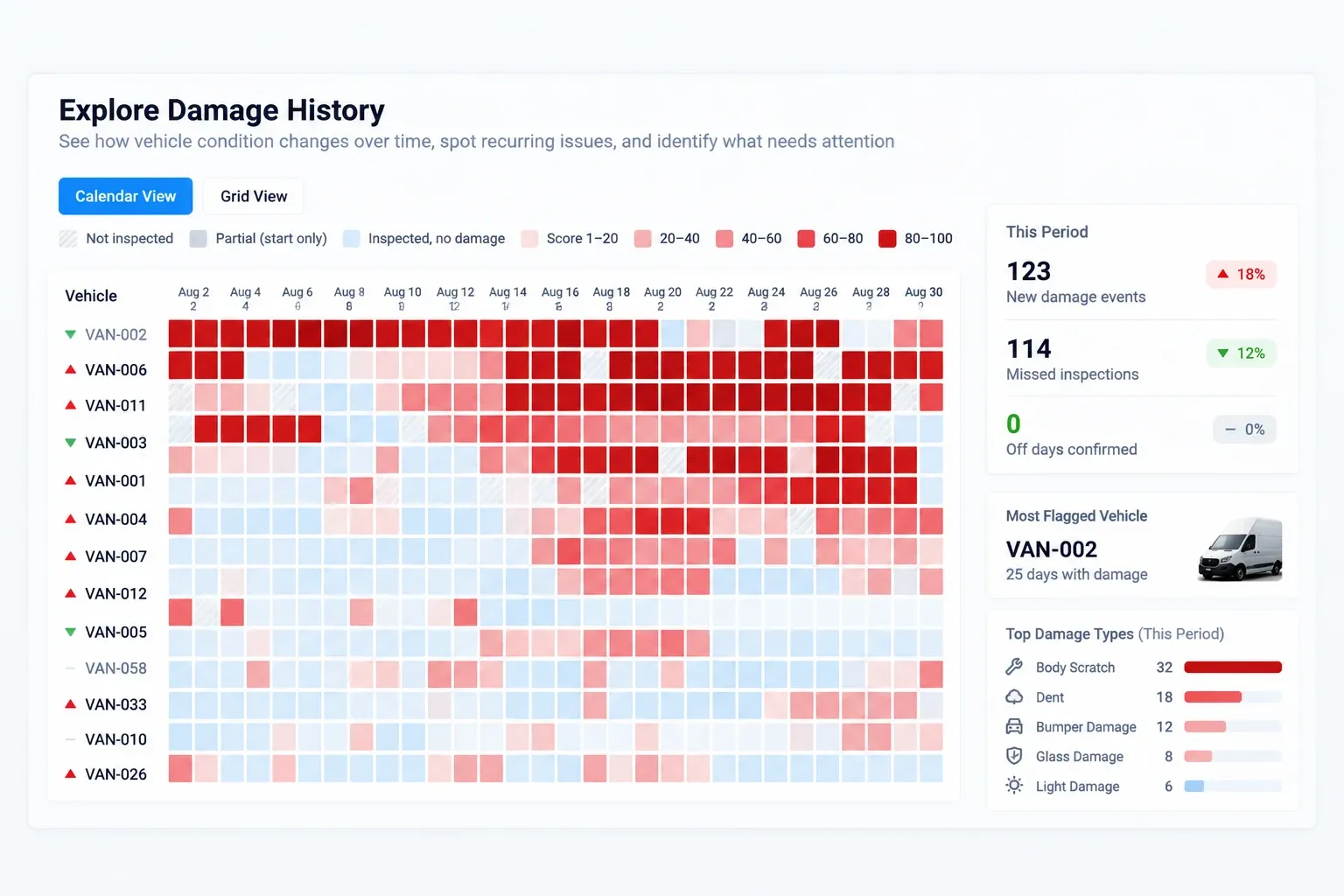
Damage history is more useful when it connects to the vehicle, the inspection event, and the assignment context. If similar damage shows up across several inspections, a manager can check whether it is a recurring problem with that vehicle or a pattern tied to a certain assignment or inspection event.
That context is not proof of who is responsible. It simply gives the manager better information for investigation and follow-up for the fleet.
How Is a Fleet Health Score Calculated?
There is no single industry-wide formula for a fleet health score. The calculation typically starts with vehicle-condition data from inspections, damage findings, repair records, and other relevant vehicle history. A scoring methodology then evaluates factors such as damage severity, inspection recency, and repair status to produce a health indicator for each vehicle. These vehicle-level assessments can then be aggregated into a fleet-level score or view.
The weighting of each factor can vary by fleet, vehicle type, operating environment, and scoring methodology. For example, a fleet may give greater weight to unresolved severe damage than to older inspection findings. The important point is to apply the same methodology consistently so that changes in the score can be tracked over time.
In simple terms:
The fleet-level score provides the overall signal, while the underlying vehicle-level data helps managers understand what is driving the result.
For Fleet Operators
Turn inspection data into smarter fleet decisions
Track vehicle condition, reduce uncertainty, and optimize repair or replacement decisions with AI powered inspections.
Fleet Health Score vs. Vehicle Health Score
A vehicle health score describes one vehicle, based on its own inspection, damage, and repair history. A fleet health score combines those individual assessments into one fleet-level view.
You need both, and neither replaces the other. The fleet-level score helps identify where attention may be needed; the vehicle-level view provides the context needed to investigate.
How Should a Fleet Manager Read a Fleet Health Score?
Treat the score as a starting point for investigation rather than a standalone decision. Start with the overall trend, then drill down into vehicle distribution, severity, recent changes, and repair status.
- Start with the fleet-level trend. See whether overall condition has gone up, held steady, or dropped over the last few inspection cycles.
- Look at the vehicle distribution. Check how many vehicles sit in each status category instead of relying on the average.
- Find the severe and high-priority vehicles. Some units need attention, whatever the fleet average says.
- Check what changed. Look for new damage or a recent change in condition since the last cycle.
- Review the evidence. Open the inspection photos, notes, and damage locations.
- Check repair status. See whether the issue is already being handled or is still open.
- Drill into history. Check whether the same issue has appeared in previous inspections, whether it is recurring, and whether earlier repairs resolved it.
Inspektlabs
See how AI vehicle inspection fits your workflow
Talk to our team in a short working session.
Fleet Health Dashboard: From Fleet-Level Visibility to Vehicle-Level Action
A fleet health dashboard brings the information behind the score into one operational view. Managers can start with overall fleet condition, identify vehicles that need attention, and drill down into the inspection, damage, history, and repair information behind each status. The score provides the high-level signal; the dashboard provides the context needed to investigate it.
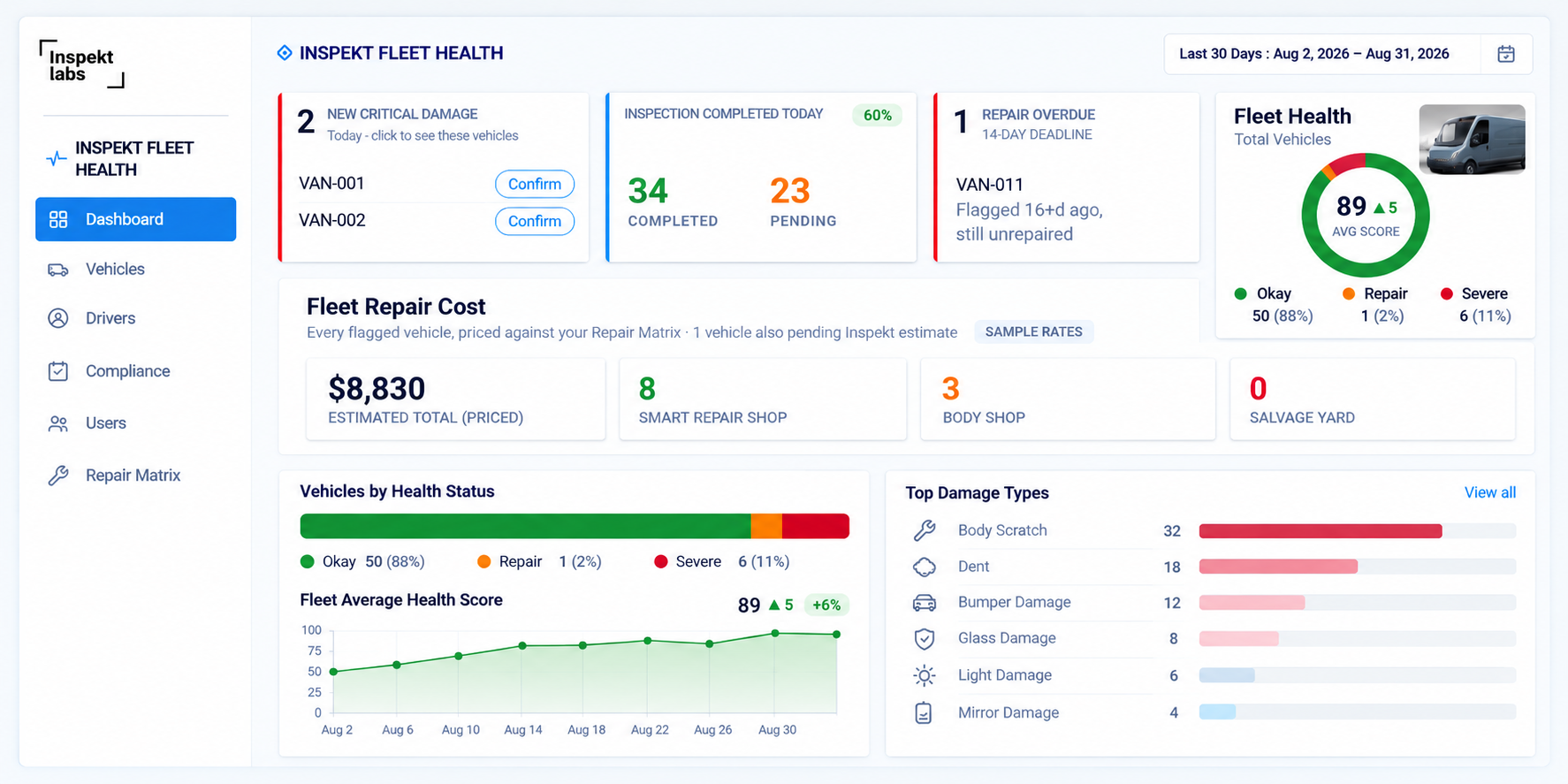
What Do "Okay," "Repair," and "Severe" Mean?
Example operational categories such as Okay, Repair, and Severe can help managers quickly triage a large fleet. In the Inspektlabs’ Fleet Inspection Software, these categories are used as operational indicators rather than universal industry or regulatory classifications.
Each fleet should set its own criteria for what counts as Repair and what counts as Severe, based on vehicle type, operating environment, and company policy.
These categories don't replace inspection evidence. They help a manager decide where to look first. A manager can begin with the Severe vehicles, review the damage and inspection evidence behind them, and then choose the right operational response.
Why a High Fleet Health Score Can Still Hide Problems
Averages smooth things out. A fleet average can hide a small number of vehicles that need immediate attention. Take a fleet of 50 vehicles with a strong average score because 44 of them are in great condition. Three vehicles have severe, unresolved damage, and three more have recurring issues tied to the same driver assignment. The average still looks healthy, since the majority pulls it up, and the small group of high-risk vehicles goes unaddressed.
Managers therefore need vehicle-level drill-down to identify the vehicles driving the risk, particularly those with severe, unresolved, or recurring issues.
What Should a Fleet Manager Do When the Score Drops?
When the score drops, start by identifying what changed and which vehicles are driving the change:
Improving fleet health requires a continuous process of inspecting vehicles, assessing damage, prioritising repairs, taking corrective action and re-inspecting to verify improvements.
- Identify which vehicles changed. A fleet-level drop usually traces back to a small group of vehicles.
- Review the latest inspection. Read the photos, notes, and specific issues instead of relying on a score or a defect label.
- Assess severity. Determine whether the finding is cosmetic, operational, or potentially safety-related.
- Check repair status. Confirm whether a fix is already underway.
- Review history and attribution. Check whether the issue was a one-off or whether the same fault has appeared before. A repeat suggests a maintenance problem that needs more focus.
- Take action. Send the finding into a repair or maintenance workflow. A flagged issue that never becomes a work order does nothing for fleet health.
- Re-inspect. Update the vehicle's record so the score shows its current state and not its state at the last flag.
How AI-Powered Fleet Inspection Can Improve Fleet Health Management?
AI-powered fleet inspection software can strengthen fleet health management by making the inspection data behind the dashboard more consistent and easier to assess at scale.
Digital vehicle inspection tools can help identify visible damage from inspection images, return structured damage information, compare current findings with available vehicle history, and speed up triage across a large number of inspections. These capabilities support the broader fleet health workflow by improving how inspection findings are captured, assessed, and prioritized.
- Capture. Guided capture helps make sure inspections are done the same way each time and from the right angles. That cuts down the gaps that otherwise show up as missing data.
- Detect. AI damage detection can help flag visible damage more consistently than a fully manual review, particularly when a large fleet produces many inspections a day.
- Compare. Vehicle history helps separate new damage from damage already logged. That keeps scoring accurate and avoids duplicate repair flags.
- Attribute. Attribution logging can connect damage to a specific inspection, vehicle, or driver assignment, which supports the drill-down described earlier.
- Prioritize. Repair-cost estimates give an early, rough signal for triage. They are not a final repair quote.
- Act and verify. Findings move into the repair workflow, and a re-inspection confirms the fix.
None of this removes the need for human judgment. A fleet manager or technician should review the output before a maintenance decision is final. Attribution and driver-related records in particular need human confirmation before anyone acts on them.
Inspektlabs Fleet Solutions
Turn Vehicle Inspection Data Into Actionable Insights
Identify damage, prioritize repairs and make more informed fleet management decisions.
What Should a Fleet Health Dashboard Show?
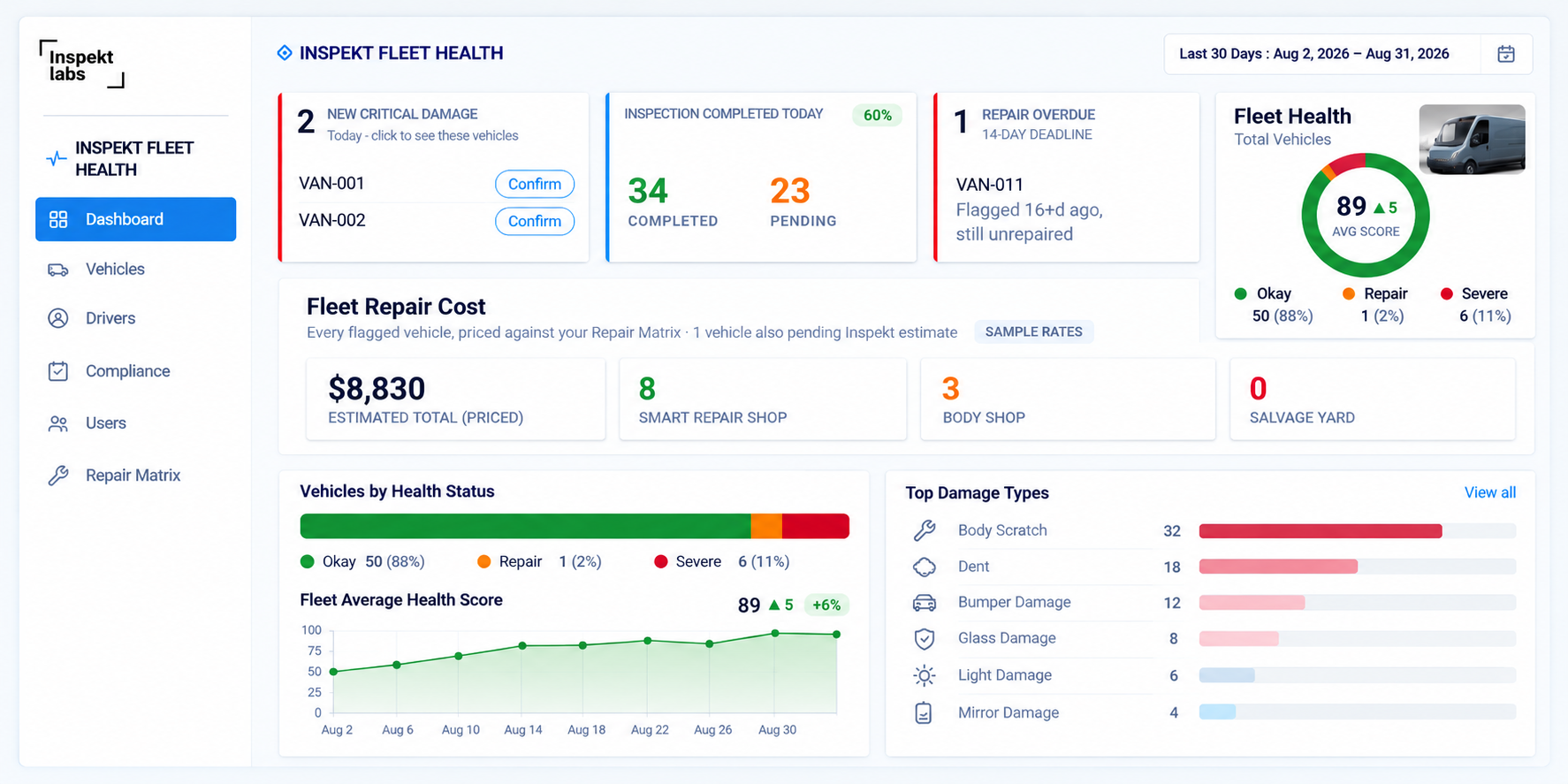
A useful fleet health dashboard should help managers answer three questions quickly: What changed? Which vehicles need attention? What should be investigated or acted on next? At a minimum, it should include the following.
Fleet-level visibility
- Fleet health score and its trend over recent inspection cycles
- Vehicle distribution across condition categories
- Okay, Repair, and Severe categories
Priority identification
- A clear list of vehicles needing attention, ranked by severity
- New severe or critical damage since the last review
- Open and overdue repair items
- Changes since the previous inspection cycle
Vehicle-level context
- Inspection history and recency, so data freshness is visible
- Damage history
- Current inspection evidence, such as photos and notes
- Damage location
- Vehicle and driver assignment context, where relevant
Action context
- Severity and repair status
- Repair-cost estimates, where available, to support triage
- Recommended next action
- Drill-down into any individual vehicle from the fleet-level view
How a Fleet Manager Could Use the Dashboard
Imagine a manager overseeing 200 vehicles. The fleet-level view shows that overall condition has declined since the previous inspection cycle.
Rather than opening every report, the manager looks at the vehicle distribution and picks out the units in the Severe and Repair categories. Next come the vehicles with newly reported damage, open repairs, and recurring findings.
One vehicle shows a damage finding that wasn't in the previous inspection. Another has the same issue recorded across several inspections. The manager reviews the evidence, checks the vehicle and assignment context, and decides whether each issue should be repaired, monitored, or re-inspected.
Common Fleet Health Score Mistakes
Some habits make a fleet health score less useful than it should be:
- Looking only at the fleet average instead of the vehicle distribution and outliers.
- Treating the score as a universal benchmark when scoring methods vary by fleet and platform.
- Relying on data that is too old or incomplete, for example, when inspections are still being missed in the background.
- Overlooking severe outliers because the fleet-level picture looks acceptable.
- Leaving a flagged issue without a repair workflow, so the same problem comes back later.
- Checking the score only now and then instead of following it as a trend.
- Treating AI-flagged output as a final decision when it should be a starting point for review.
How to Improve Fleet Health?
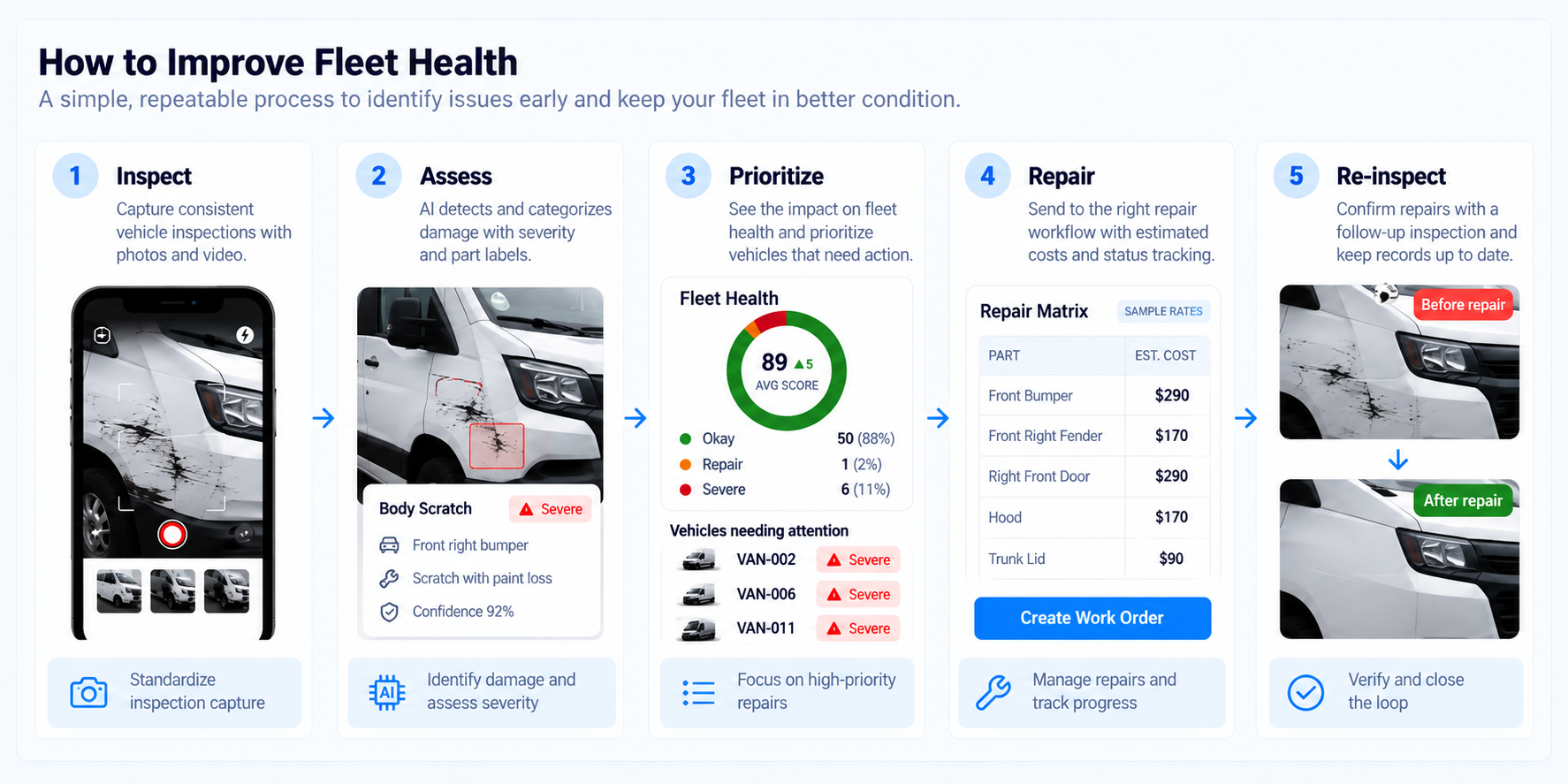
Fleet health can be improved by keeping inspection data current, addressing flagged defects promptly, and tracking recurring issues through to resolution. These three areas directly affect the quality of the fleet health data and help managers identify problems before they become larger operational issues.
The practical steps below focus on improving inspection consistency, closing repair gaps, and using vehicle history to identify recurring problems.
- Standardize inspection capture. Use the same checklist and photo angles on every vehicle, whether through vehicle inspection software or a paper process, so records can be compared from one inspection to the next.
- Fix recency where it is weakest. Find the vehicles or depots that have gone longest without a recorded inspection, and raise the frequency there first.
- Write down your Repair and Severe criteria. When the line between the two is documented, two managers will classify the same defect the same way.
- Give every Severe flag an owner and a due date. A finding with no name and no deadline tends to stay open.
- Close the loop. Link each flagged issue to a work order and follow it through to re-inspection. A preventive maintenance program helps reduce repeat repairs.
- Track repeat defects by vehicle. A defect that returns after a repair points to a repair or parts problem, not a new event.
- Keep vehicle histories in one place. A known fault shouldn't get lost across separate reports.
- Review trends on a schedule. A weekly or per-cycle review catches a slow decline that a one-off check will miss.
- Use automation selectively. Automate repetitive inspection and triage tasks to improves consistency, while allowing human review for final operational decisions.
From Fleet Health Score to Fleet Health Action
A fleet health score is most useful when it helps managers turn inspection data into timely action. By combining fleet-level trends with vehicle-level evidence, teams can identify emerging issues, prioritize repairs, and verify that conditions have improved after action.
That turns fleet health from a metric into a repeatable management process.
For Fleet Leaders
Scale smarter fleet decisions with AI insights
Analyze vehicle condition across your entire fleet, identify patterns, and optimize maintenance, procurement, and lifecycle planning.
Frequently Asked Questions
1. What is a fleet health score?
A fleet health score gives fleet managers an overview of how well their vehicles are doing. It considers factors such as inspection results, damage, repairs and maintenance to highlight vehicles that may need attention.
2. How is a fleet health score calculated?
There is no standard formula for calculating a fleet health score. It usually depends on factors such as vehicle condition, damage severity, inspection results and outstanding repairs. These assessments are then used to understand the health of the entire fleet.
3. What factors affect a fleet health score?
A fleet health score can be affected by vehicle condition, inspection findings, damage severity, pending repairs, maintenance history and how recently each vehicle was inspected.
4. What is the difference between a fleet health score and a vehicle health score?
A vehicle health score looks at the condition of one vehicle, while a fleet health score gives managers a broader view of all vehicles. It helps them spot recurring issues and identify where attention is needed across the fleet.
5. How can AI improve fleet health management?
AI can help fleet managers identify vehicle damage, assess its severity and compare current inspection results with previous records. This makes it easier to spot recurring problems and decide which vehicles need attention.