10 Best AI-Powered Car Damage Inspection Software Tools in 2026
(Updated September 2026)
The AI-powered vehicle damage detection market is estimated to reach $5.7 billion by 2032, growing at an 18% CAGR as insurers, fleet operators, rental companies, and remarketing platforms move towards replacing slow and inconsistent manual inspection processes.
Choosing a vehicle inspection platform is not only about how well it detects damage. For insurers, fleet operators, rental companies, dealerships, and automotive businesses, the inspection also needs to fit how vehicles are captured, reviewed, reported, and processed.
In this guide, we compare 10 vehicle inspection solutions and look at their capabilities, use cases, deployment options, limitations, and pricing. We also cover what to consider before choosing a platform for your own vehicle inspection workflow.
Looking to compare Inspektlabs with other vehicle inspection platforms? Explore our vehicle inspection software comparison hub to see how Inspektlabs compares with other inspection solutions.
What is AI Car Damage Detection?
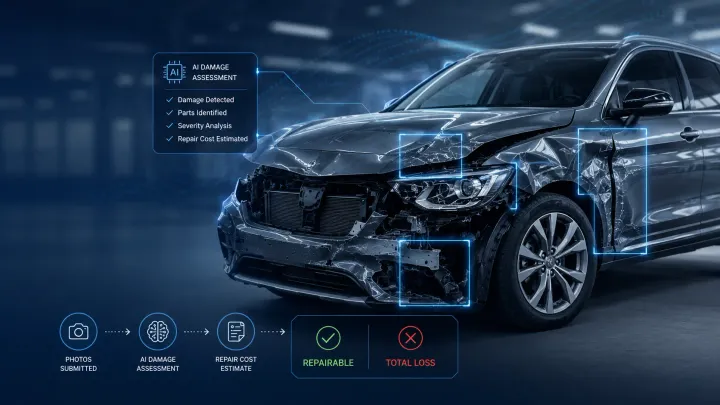
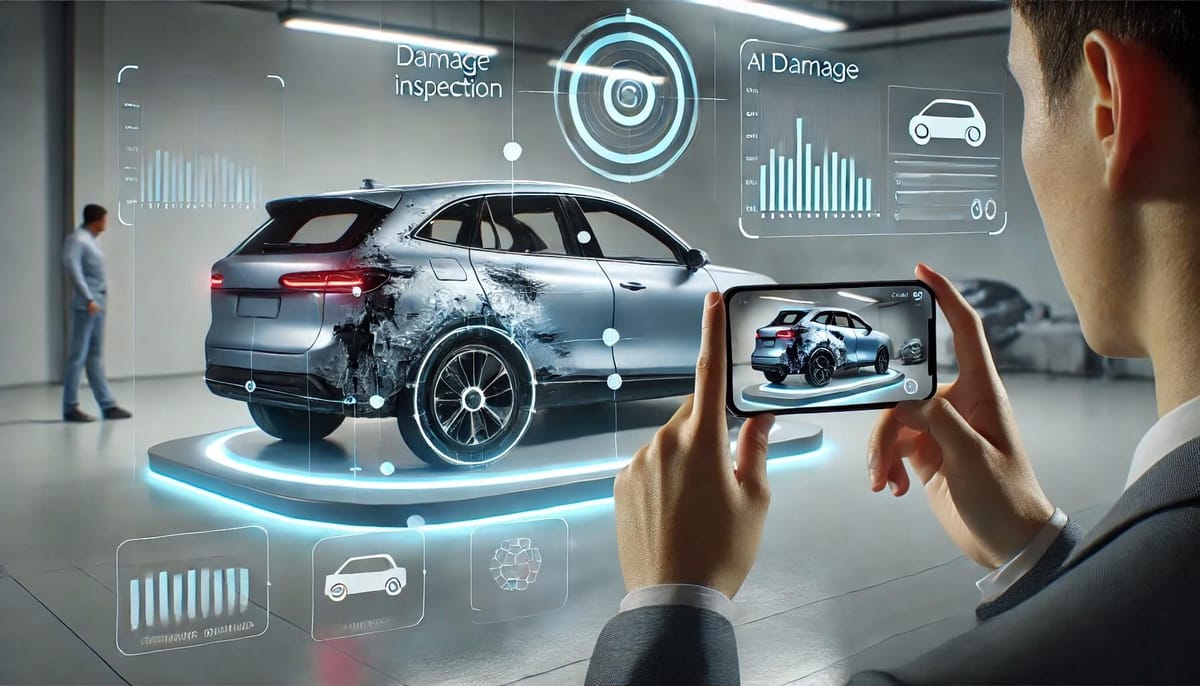
AI car damage detection uses computer vision to identify visible vehicle damage from photographs or video. Depending on the platform, it can detect dents, scratches, cracks, broken components, and other visible defects, then organise the findings by vehicle part for an inspection or damage report.
The technology is useful for high-volume inspections across insurance, rental, fleet, dealerships, auctions, and remarketing. However, results can vary depending on image quality, lighting, camera angle, vehicle visibility, damage type, and the areas captured.
For a detailed explanation, read our complete guide on AI car damage detection.
How Does Car Damage Detection Work?
A typical vehicle damage inspection follows a fairly straightforward process, although the exact workflow varies between platforms.
1. Capture the vehicle
The vehicle is photographed or recorded using a smartphone, inspection device, or fixed-camera setup.
2. Check the submitted media
The system checks whether the images or video provide enough information for the inspection. Some workflows can flag missing views, poor-quality images, or other capture issues.
3. Identify the vehicle and relevant areas
The submitted media is processed to identify the vehicle and the parts visible in the inspection.
4. Detect visible damage
The software analyses the captured images or video to identify visible damage.
5. Organise the findings
Detected damage can be associated with the affected vehicle part and categorised according to the capabilities of the platform.
6. Generate the inspection result
The findings can then be presented in a structured inspection report or passed into another system through an integration.
This process can reduce the amount of manual work involved in routine inspections, while human review can still be used where a case requires additional assessment.
Who Uses Car Damage Inspection Software?
Vehicle inspection software is used across industries where teams need to document vehicle condition regularly or at scale. Although the workflow differs from one business to another, the basic requirement is similar: capture reliable vehicle evidence, identify relevant damage, and create a record that can be used by the next team in the process.
1. Insurance: Insurers can use vehicle inspection software for pre-insurance checks, claims, damage assessment, and other stages where the condition of a vehicle needs to be documented.
2. Fleet Management: Fleet operators can use inspections during vehicle handovers, check-in and check-out, periodic condition checks, maintenance workflows, and remarketing.
3. Car Rental: Rental companies can document vehicle condition before and after a rental period and create a consistent record of any newly reported damage.
4. Dealerships: Dealerships can use inspection software during vehicle intake, trade-ins, appraisals, inventory checks, and resale preparation.
5. Auctions and Remarketing: Auction and remarketing teams can document vehicle condition before a vehicle reaches potential buyers, making the inspection record easier to share and review.
6. Automotive and Mobility Platforms: Automotive and mobility businesses can integrate inspection capabilities into their existing platforms when they need vehicle condition data as part of a larger workflow.
Vehicle Damage Inspection Software vs. Manual Inspection
Manual inspection still has an important role, particularly when a vehicle requires physical assessment or specialist judgement. For high-volume, repeatable inspections, however, software can take care of several routine steps and make the process easier to standardise.
| Factor | Manual Inspection | Software-Based Inspection |
|---|---|---|
| Vehicle capture | Inspector takes photographs | Guided photo or video capture |
| Damage review | Manual assessment | Automated image analysis |
| Inspection location | Usually physical | Can support remote inspection |
| Reporting | Manually prepared | Structured report generation |
| Processing time | Depends on inspector availability | Designed for repeatable workflows |
| Consistency | Can vary between inspectors | Standardised capture and review |
| Scalability | Limited by field resources | Suitable for higher inspection volumes |
| Integration | Often a separate process | API/SDK options may be available |
In practice, the two approaches can also work together. Software can handle routine capture and initial assessment, while human reviewers can step in when the inspection needs additional investigation.
Quick Comparison: 10 Car Damage Inspection Software Solutions
The table below summarises all 10 Best AI vehicle Inspection tools on the criteria that B2B buyers prioritise most. The Inspektlabs row (highlighted) is also the most detailed entry in the list that follows.
The 10 Best AI Vehicle Damage Inspection Software Tools (2026)
1. Inspektlabs
Founded: 2018 | Best for: Insurance, Fleet, Rental, Remarketing
Inspektlabs is a multi-industry AI vehicle inspection platform built around a proprietary computer vision model trained on 30 million+ real-world damage images. The AI identifies 21 types of damage detection across 163 vehicle parts with 95 to 99% accuracy, covering everything from exterior panels and glass to interior components such as seats and headliners. That training depth is one of the largest published datasets in this category and has been validated by clients from across the world.
Its inspection workflow can be integrated into existing systems, allowing businesses to use vehicle inspection as part of a wider claims, fleet, rental, or automotive process rather than as a standalone activity.
Industry-specific highlights:
- Insurance: Automated damage assessment with built-in fraud detection. Estimatics integrations with Mitchell (North America) and GTMotive (Europe) deliver instant repair estimates alongside the damage report. Claim cost reduction of 30 to 40% is reported by insurance clients.
- Fleet: Incremental damage tracking during check-in and check-out along with real-time notifications for new damage identified. Standardizes reporting across multi-site operations and reduces the manual inspection burden on fleet managers.
- Rental: Inspection reports can be generated during vehicle receipt and upon vehicle return, reducing dispute resolution time and improving the customer handback experience.
- Remarketing: Generates condition reports compatible with certified grading standards such as NAMA, AutoIMS, and more, supporting transparent pricing in used-car auctions and dealer channels.
Additional strengths:
- Real-time image quality checks reject blurry images, captured in bad lighting, or with bad angles during the inspection, before they enter the assessment workflow
- Drive-through vehicle camera scanner option for high-volume sites, capable of processing up to 120 vehicles per hour
- ISO 27001 certified and GDPR compliant
Limitations: Inspektlabs’ partner integrations can generate repair cost estimates, but only for select markets. Micro damages on very dark or heavily textured paint surfaces are detected only when the image/video is captured in favourable conditions. Farm vehicles and specialist machinery are outside the scope of the AI model.
Pricing: Volume-based model; contact Inspektlabs for a quote. Free trial: up to 100 inspections at no cost.
2. Ravin AI
Compare Inspektlabs vs Ravin AI →
Founded: 2018 | Best for: Rental, Fleet, Insurance
Ravin AI is built on DeepDetect, a proprietary damage detection technology that has been granted patents in the US, EU, and Japan. The platform supports both smartphone-based capture and fixed-camera AutoScan installations. Its RepairIQ product, launched in late 2024, added repair cost estimation to what had been a damage-detection-only offering.
Key strengths:
- Patented DeepDetect technology recognised by TIME magazine as one of AI's breakthrough technologies
- Major rental clients including Avis Budget and Hertz; users report up to 50% reduction in damage capture and cycle time
- RepairIQ enables the product to become an end-to-end solution by expanding the platform into repair assessment territory.
Limitations: AutoScan hardware deployment requires site installation and increases upfront cost. Pricing is at the premium end of the market. Historically stronger in rental and automotive retail than insurance claims workflows.
Pricing: Premium tier; contact for pricing.
Comparing AI vehicle inspection solutions? See how Inspektlabs compares with Ravin across vehicle inspection workflows—or talk to our team about your specific use case.
3. Tractable
Compare Inspektlabs vs Tractable →

Founded: 2014 | Best for: Insurance, Repair networks
Tractable is one of the most widely deployed AI damage assessment platforms in the motor insurance sector. Its two-step process shares an inspection link with the vehicle owner, who uploads images that the AI then assesses on Tractable's web platform. The system is trusted by more than 20 leading global insurers.
Key strengths:
- Provides integrations with estimatics partners such as Mitchell (North America) and Eurotax (Europe) for OEM part pricing and repair data
- Trusted by 20+ major insurers such as GEICO, Beesafe, and more with a proven track record in claims acceleration
- The AI model is trained on millions of images with a strong coverage of country-specific repair practices.
Limitations: Built specifically for insurance and repair networks; limited applicability to fleet, rental, or remarketing. Sits at the premium pricing tier.
Pricing: Premium; contact for pricing.
Comparing AI vehicle inspection solutions? See how Inspektlabs compares with Tractable across insurance, fleet, rental, and remarketing workflows—or talk to our team about your use case.
4. Monk AI
Compare Inspektlabs Vs Monk AI →

Founded: 2019 | Best for: Rental, Used car / Automotive retail
Monk AI, acquired by ACV Auctions in February 2022, provides 360-degree vehicle scanning via smartphone with damage reports delivered through a web dashboard. Its SDK and API integration options make it relatively straightforward to embed into existing rental or dealer platforms, and the ACV acquisition has strengthened its North American distribution.
Key strengths:
- Simplified integration into existing apps, thanks to a lightweight SDK.
- Guided capture UX reduces inspector training requirements
- ACV Auctions backing provides strong distribution in the US auction and remarketing channel
Limitations: AI damage detection is limited only to surface damage. Reports do not cover repair cost estimates, which limits the platform to the detection layer instead of an end-to-end assessment platform.
Pricing: Contact for pricing.
5. DeGould

Founded: 2011 | Best for: OEM, Vehicle logistics
DeGould specialises in automated vehicle inspection at manufacturing and logistics sites using proprietary fixed-camera hardware combined with AI software. The system was designed for OEM quality control and vehicle-off-truck condition capture, addressing common imaging challenges such as inconsistent lighting.
Key strengths:
- Their hardware is built speficially to deliver highly controlled image quality for consistent AI performance
- Strong deployment history at OEM and vehicle distribution centres across Europe
- It covers the full logistics inspection lifecycle from production exit to dealer delivery.
Limitations: Designed mainly for OEMs and logistics companies. It’s not recommended for insurance, rental, or fleet vehicle inspections, and requires expensive hardware setup and installation.
Pricing: Premium (hardware + software); contact for pricing.
6. WeProov
Compare Inspektlabs Vs WeProov →
Founded: 2015 | Best for: Fleet management
WeProov provides a mobile-first inspection platform for fleet management companies. Drivers or fleet managers capture vehicle condition via the WeProov app, with reports tracked centrally via a web dashboard. The product is designed around documentation and dispute prevention for long-term fleet asset management.
Key strengths:
- It uses a centralized damage tracking database built for large, multi-site European fleet operations.
- Both driver-facing mobile capture and back-office reporting can be managed in one place.
- Has an established market presence across European Fleet companies
Limitations: Optimised for fleet only. API and third-party integration options are more restricted than competitors. App has a learning curve for new users.
Pricing: Contact for pricing.
7. UVeye
Founded: 2014 | Best for: OEM, Dealerships, High-volume fleet
UVeye provides vehicle inspection automation using fixed cameras, designed for dealerships, OEMs, and fleet operators. Vehicles drive through at normal speed through a pre-decided layout, while high-resolution cameras capture the exterior, undercarriage, and the tyre and wheel condition. The platform is suited to high-throughput operations that need fast, repeatable condition capture.
Key strengths:
- They provide Undercarriage scanning capability which is a genuine differentiator for safety-focused inspection use cases
- Tyre tread and wheel condition analysis is more detailed than most mobile-first platforms
Limitations: Their hardware installation requires huge capital and a big enough physical space for initial setup. Not suited to remote or distributed operations. Limited insurance workflow integration.
Pricing: Premium (hardware + software); contact for pricing.
8. Pave AI
Compare Inspektlabs Vs Pave AI →

Founded: 2017 | Best for: Used car / Automotive retail (North America)
Pave AI provides smartphone-based vehicle inspection via enterprise APIs and SDK integrations, designed to make any non-expert capable of completing a thorough inspection. It has found its strongest fit with automotive marketplaces and dealers in North America.
Key strengths:
- Inspector training time is reduced thanks to their guided capture UX.
- Can be embedded into existing platforms with a strong API and SDK documentation.
- Good fit for consumer-facing inspection workflows at point of sale or purchase
Limitations: They mostly focus on the North American automotive retail. Less suited to insurance, fleet, or rental verticals. Does not currently offer end-to-end repair estimation.
Pricing: Contact for pricing.
9. Claim Genius

Founded: 2017 | Best for: Motor insurance
Claim Genius’ AI solutions are built exclusively for motor insurance companies, covering damage assessment, claims triage, total loss prediction, and insurance underwriting. It is positioned as an end-to-end insurance workflow solution with integration options customized to fit into existing claims management systems.
Key strengths:
- They have built a deep insurance workflow integration that covers the full claims lifecycle from start to end.
- They also help in making total loss predictions and share repair vs. replace guidance, which adds value beyond basic damage detection.
- Highly customizable to easily fit the insurers’ workflows with documented integration options
Limitations: Designed exclusively for insurance. Fleet, rental, and remarketing operations are outside the product scope.
Pricing: Contact for pricing.
10. Bdeo

Founded: 2016 | Best for: Insurance (Europe, Latin America)
Bdeo provides AI visual intelligence for insurance companies, automating claims and underwriting processes. The platform has its strongest footprint in European and Latin American insurance markets, with tailor-made deployment models as a core part of the offering.
Key strengths:
- They provide a deep regional expertise in European and Latin American insurance markets and regulatory environments
- End-to-end insurance product covering claims, underwriting, and fraud detection
- They can configure Tailor-made deployments to insurer-specific workflows
Limitations: Mainly catering to the European and Latin American markets; they are less suited to North American or Asia-Pacific deployments. Not applicable to fleet, rental, or remarketing.
Pricing: Premium; contact for pricing.
AI Vehicle Inspection Alternatives and Competitors
Comparing several platforms is a normal part of the software selection process. Businesses may look for an alternative based on their inspection method, deployment requirements, integrations, supported use cases, or commercial model.
Rather than looking only at which provider has the longest feature list, it is worth comparing each platform against the workflow you actually need to support.
UVeye Alternatives
Businesses considering alternatives to UVeye may want to compare fixed-camera and mobile inspection options, deployment requirements, vehicle coverage, reporting, integrations, and the type of inspection environment each platform supports.
Compare Inspektlabs with UVeye →
Ravin AI Alternatives
When evaluating alternatives to Ravin AI, businesses can compare the available capture methods, damage detection capabilities, reporting, integration options, deployment model, and supported vehicle inspection workflows.
Compare Inspektlabs with Ravin AI →
Tractable Alternatives
Businesses evaluating alternatives to Tractable can compare how each platform handles vehicle capture, damage assessment, reporting, integrations, and insurance-related workflows.
Compare Inspektlabs with Tractable →
Monk AI Alternatives
Monk AI can also be considered alongside other vehicle inspection platforms. The main areas to compare include inspection coverage, capture methods, damage assessment, integrations, and the workflows supported by each provider.
Compare Inspektlabs with Monk AI →
How to Choose Vehicle Damage Inspection Software
The right inspection platform depends on the way your business handles vehicles today. A rental company may care most about quick check-in and check-out inspections, while an insurer may need claims integration and structured damage evidence.
Before choosing a platform, consider the following areas.
-
Damage Detection Coverage
Start with the basics: what can the platform actually detect? Check the types of damage covered, the vehicle parts supported, and whether the system can handle the conditions found in your own inspection workflow.
-
Photo and Video Capture
Consider how vehicles will be captured. Some businesses rely on individual photographs, while others may benefit from guided video or 360° capture. The capture process should be simple enough for employees, customers, or drivers to follow consistently.
-
Remote Inspection
If vehicles are spread across branches, customer locations, or fleet sites, remote inspection can reduce the need for an inspector to visit every vehicle. Check how the platform guides the user and validates the submitted evidence.
-
Inspection Reports
The output matters just as much as the detection itself. Look at how findings are presented, whether images are included, whether damage can be associated with vehicle parts, and whether reports can be customised for your workflow.
-
API and SDK Integration
For businesses that already have claims, fleet, rental, dealership, or mobility software, integration can be a major consideration. Check whether the provider offers APIs, SDKs, webhooks, or other options for connecting inspection data to existing systems.
-
Repair Estimation
Damage detection and repair estimation are not the same thing. If repair costs are part of your workflow, check whether the platform provides estimation capabilities or can connect with a separate repair estimation system.
-
Evidence and Fraud Checks
Some inspection workflows require more than damage detection. Image quality, vehicle identification, required views, timestamps, and other evidence may also need to be checked before an inspection can move forward.
-
Scalability
A platform that works for a small pilot may need to handle much larger volumes later. Consider processing capacity, API limits, support for multiple locations, and how easily the workflow can be expanded.
-
Security and Data Handling
Vehicle inspections can involve images, vehicle identification information, and personal data. Businesses should understand how this information is stored, processed, transferred, and protected.
-
Pricing
Pricing models vary between providers. Some charge by inspection or API usage, while others use subscription or enterprise pricing. Compare the total cost against your expected inspection volume rather than looking only at the headline price.
How Accurate Is Vehicle Damage Detection?
Accuracy is an important consideration when evaluating vehicle inspection software, but published percentages should not be compared without looking at how they were measured.
Different providers may use different datasets, damage categories, vehicle types, image conditions, and definitions of accuracy. A percentage reported by one company may therefore not be directly comparable with another company's figure.
For example, Inspektlabs currently reports 95–99% accuracy for AI-powered vehicle damage detection, based on its proprietary vehicle damage detection technology. Its published methodology explains that the system uses a combination of object detection and segmentation models and addresses challenges such as reflections, perspective, lighting, overlapping damage, and micro-damage.
When evaluating a platform, look at:
- Damage types covered
- Vehicle parts supported
- Image and video quality requirements
- Performance across different vehicle types
- False positives and missed damage
- Human review options
- Results using your own vehicle images
A practical test using representative vehicles and inspection conditions can often tell you more about whether a platform is suitable for your workflow than a single published accuracy number.
Vehicle Inspection Software for Dealerships
Dealerships deal with vehicle condition at several points, from receiving a vehicle to preparing it for sale. Inspections may be required during vehicle intake, appraisal, trade-ins, inventory checks, and remarketing.
A structured inspection process gives dealership teams a consistent way to document vehicle condition rather than relying on different inspection methods at different locations.
When evaluating software, dealerships should consider:
- Speed of vehicle capture
- Damage coverage
- Inspection report format
- Mobile inspection capabilities
- Support for multiple locations
- Integration with existing dealership systems
- Ability to retain vehicle condition records
For larger dealership groups, consistency across locations can be just as important as the inspection technology itself.
Vehicle Damage Inspection Software for Fleets
Fleet operators may inspect the same vehicle several times during its lifecycle. A vehicle can be checked when it is handed over to a driver, returned to a depot, involved in an incident, sent for maintenance, or prepared for resale.
Having a consistent digital inspection process makes it easier to document those changes and maintain a record of vehicle condition over time.
Common fleet inspection use cases include:
- Vehicle check-in and check-out
- New damage identification
- Driver-assisted inspections
- Periodic condition checks
- Maintenance workflows
- End-of-lease inspections
- Remarketing and resale
For larger fleets, remote capture and integration with existing fleet systems can also reduce the administrative work associated with routine inspections. Read our guide for fleet operators and owners on Automating Fleet Inspections with AI to explore how AI can support fleet inspection workflows.
Vehicle Damage Inspection Software for Insurance
Insurance is one of the most common applications for digital vehicle inspection. Insurers can use vehicle inspections during pre-insurance checks, claims, damage assessment, and other stages where vehicle condition needs to be documented.
Remote inspection can allow policyholders or other users to capture vehicle photos or video from their smartphones. The submitted evidence can then be reviewed and processed as part of the wider insurance workflow.
The main benefit is not simply faster damage identification. A structured inspection also gives claims and underwriting teams a consistent record of the vehicle condition and supporting evidence.
For a deeper look at insurance use cases, see our guides on car inspection for insurance and motor insurance claim inspection.
Inspektlabs: An All-in-One Vehicle Inspection Platform
Most AI inspection tools are purpose-built for a specific vertical. Insurance-focused platforms, OEM and logistics solutions, and fleet inspection tools may each be designed around different operational requirements.
Inspektlabs is designed as an all-in-one digital vehicle inspection solution, supporting multiple vehicle inspection workflows across insurance, fleet, rental, remarketing, and automotive use cases.
The platform can support different stages of the vehicle lifecycle, from insurance inspections and claims-related assessments to fleet check-ins, vehicle condition reporting, and remarketing inspections. This cross-vertical approach can be useful for businesses that need to support multiple inspection workflows through a single platform.
Key capabilities
- Vehicle damage detection
- Photo and video-based inspection
- Remote vehicle inspection
- Guided vehicle capture
- Structured inspection reporting
- Vehicle identification
- Fraud-related inspection workflows
- API and SDK integration
- Repair estimation capabilities
Why this matters for B2B buyers
Businesses operating across multiple vehicle workflows may prefer a platform that can support different inspection requirements without maintaining separate inspection technologies for each use case.
| Evaluation Criteria | What to Look For |
|---|---|
| Accuracy | Published methodology, damage coverage, testing conditions, false positives and missed damage |
| Parts Coverage | Number and types of vehicle parts supported |
| Industry Fit | Insurance, fleet, rental, remarketing, dealerships, OEM and other relevant workflows |
| API Integration | API/SDK availability, documentation, integration timeline and deployment options |
| Fraud Detection | Image validation, vehicle identification, evidence checks and fraud-related workflows |
| Compliance | Data protection, security certifications and regional compliance requirements |
| Repair Estimation | Availability of repair estimation or integration with estimating systems |
| Free Trial / Pilot | Availability of a trial, pilot or evaluation using representative vehicle data |
The right solution still depends on factors such as inspection volume, supported damage types, deployment model, integration requirements, and the specific workflows the business needs to automate.
Explore how Inspektlabs compares with other vehicle inspection solutions →
Frequently Asked Questions
What is AI car damage detection?
AI car damage detection uses computer vision to identify visible vehicle damage from photographs or video. Depending on the platform, the detected damage can be associated with vehicle parts and included in an inspection report.
How does vehicle damage detection work?
Vehicle images or video are captured and processed to identify relevant vehicle areas and visible damage. The results can then be organised into a structured inspection report or passed to another system.
What types of vehicle damage can software detect?
Depending on the provider, vehicle inspection software can identify visible damage such as dents, scratches, cracks, broken components, and other exterior defects. Coverage varies by platform and inspection setup.
Can vehicle inspections be completed remotely?
Yes. Remote vehicle inspections can use guided photographs or video captured through a smartphone, provided the inspection workflow supports remote capture.
What is the difference between damage detection and vehicle inspection software?
Damage detection focuses on identifying visible damage. Vehicle inspection software covers a broader workflow that can include guided capture, vehicle identification, damage assessment, reporting, evidence collection, and integrations.
How accurate is vehicle damage detection?
Results depend on image quality, vehicle visibility, damage type, vehicle part coverage, and the technology used. Published accuracy figures should be considered alongside the provider's testing methodology and, where possible, tested using representative vehicle data.
What is the best vehicle inspection software for dealerships?
The right solution depends on the dealership's inspection volume, capture method, damage coverage, reporting requirements, integrations, and deployment model. These factors should be evaluated against the dealership's actual workflow.
How much does vehicle damage inspection software cost?
Pricing varies by provider and may depend on inspection volume, features, integrations, deployment requirements, and the commercial model. Providers may charge per inspection, through API usage, subscription plans, or enterprise agreements.