AI Vehicle Inspection: How It Works and Key Benefits
The vehicle inspection industry is in the midst of a rapid transformation, and digital transformation is reshaping the way vehicles are evaluated. This blog explores what's fueling the market growth and why businesses are quickly embracing this technology.
Key Takeaways
- AI vehicle inspection uses computer vision and machine learning to detect, classify, and report vehicle damage from photos or video.
- It replaces manual walkaround checks with a faster, more consistent, and scalable digital process.
- Insurers, fleet operators, rental companies, and dealerships are the primary adopters.
- AI-powered inspections take 3 to 5 minutes and generate structured reports in under 90 seconds.
- The global AI vehicle inspection market is growing at a CAGR of over 18%, driven by speed, labour costs, and regulatory pressure.
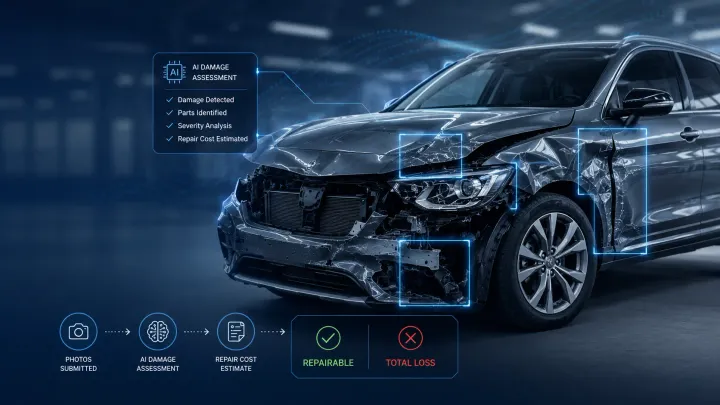
Automated vehicle inspection uses artificial intelligence to assess a vehicle’s condition from photos or video. It detects damage, classifies it by type and severity, and produces a structured condition report automatically. No physical inspector needs to be present.
The vehicle inspection industry is in the midst of a rapid transformation, part of a broader evolution of vehicle inspections spanning decades, from experts physically examining vehicle damage, wear and tear, or mechanical issues, to today's automated systems.
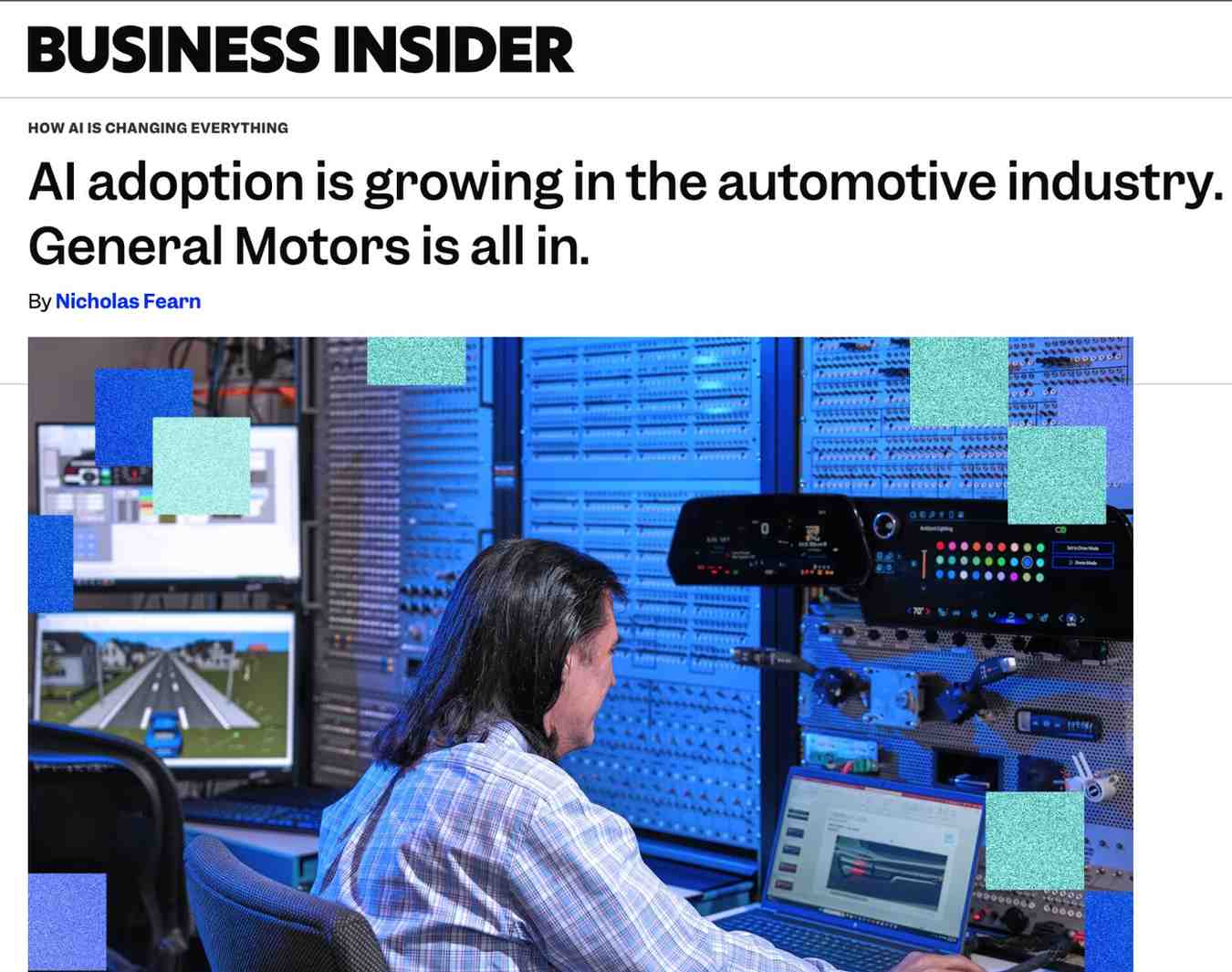
Popular publications like Business Insider predict that the broader AI automotive technology market, which is currently estimated at $4.8 billion, could reach $186.4 billion in the next decade; a clear sign of increasing demand and adoption across industries.
In this blog, we will build a complete picture of AI-powered vehicle inspection. How AI-powered vehicle inspections work, which industries they’re relevant for, its benefits, why there’s increased adoption, and how they can be implemented for your business.
How AI Vehicle Inspection Works
The process follows a consistent sequence regardless of the industry using it.
- Image or video capture: The vehicle owner, driver, or fleet operator captures pictures/videos of the vehicle using a smartphone app or fixed camera system. A guided capture flow ensures all required angles are covered. Inspektlabs automatically checks photo and video quality before the AI assessment begins, rejecting substandard media and prompting resubmission.
- Computer vision detection: The captured media is then uploaded to a cloud, where a computer vision model analyzes every frame. It scans for visible damage across all major vehicle components, from panel dents and scratches to glass chips and tyre deformation. Machine learning in automotive inspection means the model improves with every submission it processes, trained on millions of real-world damage images.
- Damage classification by type, location, and severity: Each issue on the vehicle that’s identified is classified. The AI labels the damage type (dent, scratch, crack, deformation), pinpoints the location on the vehicle, and assigns a severity level. This structured output is what makes the report actionable.
- Structured report generation: A complete vehicle condition report is generated in approximately 90 seconds. The report documents every finding with damage type, location, severity classification, and estimated repair cost. It is timestamped and tamper-proof on creation.
- Integration with downstream workflows: The report can then be used to assess insurance claims, track fleet health, check vehicle condition before and after a rental trip, and more.
Inspektlabs
See how AI vehicle inspection fits your workflow
Talk to our team in a short working session.
Vehicle Inspection Technology: Capture Formats
AI-powered vehicle inspection can be implemented using two methods. The right one depends on inspection volume, site structure, and operational context.
Smartphone app: This is a very easy, low-effort, and most common setup. A driver, customer, or fleet inspector captures the vehicle using a guided mobile app. No fixed infrastructure required. This works across distributed fleets, insurance pre-inspections, and any scenario where vehicles are not returning to a central depot. Inspektlabs' smartphone inspection covers over 100 vehicle components and works on any modern mobile device through a guided Smartphone Vehicle Inspection process.
Fixed camera scanner: Designed for high-volume, fixed-site operations. A vehicle drives through a scanning bay equipped with multiple cameras. The system captures it from all required angles automatically and generates the condition report without any user input. Best suited to airport rental depots, fleet yards, and auction centres processing 50 or more vehicles per day using scanners or fixed cameras for inspection systems.
AI Vehicle Inspection Use Cases Across Industries
- Insurance: AI car inspection replaces field adjuster visits for pre-policy checks, break-in renewals, and FNOL damage assessment. Inspektlabs reduces pre-inspection time from 2 to 5 days to under 5 minutes. Fraud detection runs as part of the same AI pass, flagging pre-existing damage and inconsistencies between the claim and the visual evidence.
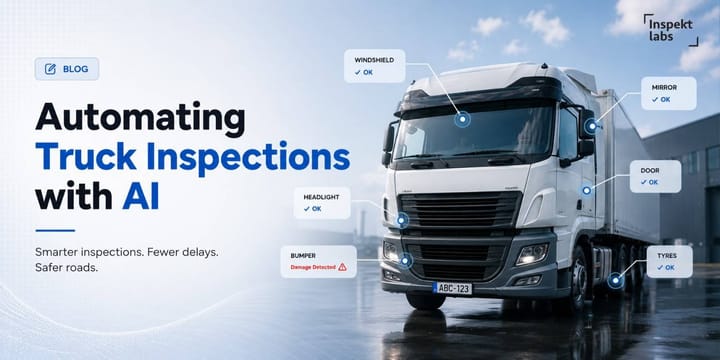
- Fleet management: AI-powered vehicle inspection at shift handover creates a continuous damage record across every vehicle in the fleet. Incremental damage is tracked automatically between inspections. Maintenance issues are flagged early. Inspektlabs' AI Vehicle inspection for fleet integration feeds inspection data directly into maintenance scheduling and driver accountability workflows.
- Vehicle rental: Automatic vehicle inspections at check-in and check-out document the condition of every rental. Timestamped reports resolve return disputes quickly using automated vehicle inspection workflows for rental operations. High-volume depot operations typically use fixed scanners, while distributed rental locations rely on smartphone-based inspection apps depending on operational needs.
- Dealerships and used-car platforms: Automated vehicle inspection for dealerships produces standardized condition reports for every vehicle in stock. These reports also help the dealer replace subjective grading with consistent, documented assessments that buyers and lenders can rely on. This supports fair pricing and reduces post-sale disputes through AI-powered car inspection for motor auctions.
Benefits of AI-Powered Vehicle Inspection
The table below summarises the core benefits of automated vehicle inspection, what each one means in practice, and who gains most. Inspektlabs data (pending internal verification) indicates a cost reduction of up to 90% per inspection compared to manual field inspection. All figures should be confirmed with the data team before publication.
AI vs Manual Vehicle Inspections: The Key Difference
For a full seven-parameter comparison, see a detailed breakdown of AI vs manual vehicle inspection across accuracy, cost, and scalability.
Why the market is growing
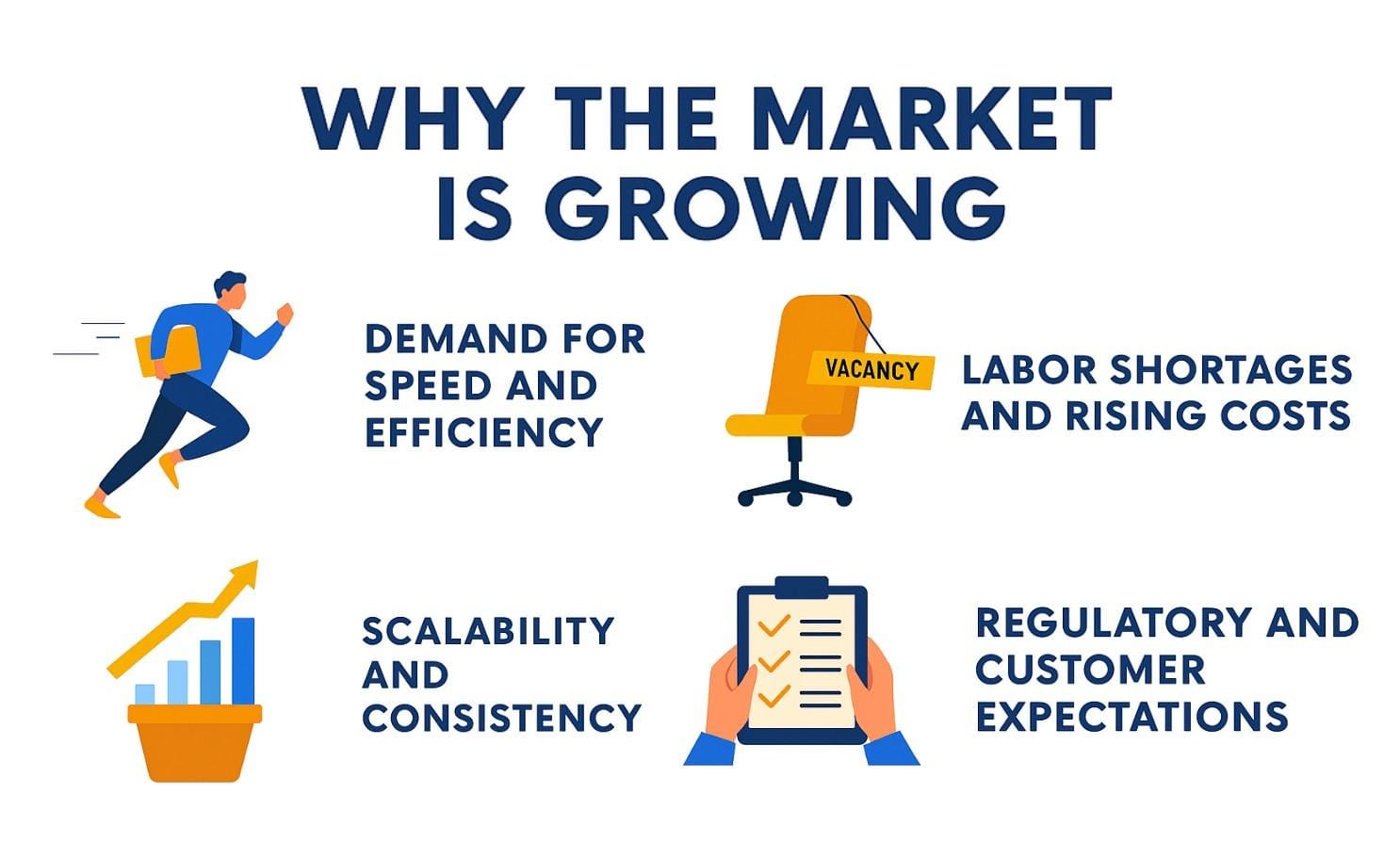
There’s a growing trend in the adoption of AI vehicle inspection software worldwide. According to Industry Research analysis (2026), over 92 million vehicles were inspected using Artificial Intelligence in 2024, accounting for approximately 38% of all vehicle inspections globally.
Several factors are driving this.
- Speed and labour costs: Manual inspections are expensive and slow, one of several factors pushing businesses toward broader cost-cutting strategies across the industry. Businesses managing high volumes cannot scale without automation.
- Regulatory pressure: The European Union has announced plans requiring AI vehicle inspection systems for all commercial vehicles by 2028. Regulatory mandates are bringing adoption forward on a fixed timeline.
- Customer expectations: Policyholders, renters, and buyers expect faster, transparent, and documented inspections. This cannot be achieved at a large scale using manual inspection processes.
- Data and fraud control: Paper-based processes do not provide the reliability that Insurers and fleet operators require in their records. AI-powered inspections very easily tackle this problem.
The market reflects this momentum. According to Technavio (2024-2029), the global AI vehicle inspection system market is projected to grow by $2.71 billion between 2024 and 2029, at a CAGR of 23.3%.
Challenges of Automated Vehicle Inspection Systems
AI vehicle inspection is highly capable. It also has real limitations that businesses should understand before deployment.
- Image quality dependency: The AI output is only as good as the media submitted. Poor lighting, incomplete capture angles, or low-resolution images reduce accuracy. Inspektlabs addresses this with an automated quality gate that rejects substandard submissions within 15 seconds and prompts resubmission before the assessment runs.
- Data privacy and compliance: Vehicle inspections constantly require newer images/videos to improve, which could also include some PII (personal identifiable information) such as face, address, license plate etc. If not handled properly, this data might be unknowingly shared with AI models. Additionally, businesses operating in the EU and UK must comply with GDPR.
- Change management: Teams accustomed to manual processes need onboarding when switching to automated systems. The technology is straightforward. The process change takes more active management.
Regional Adoption of AI Vehicle Inspections
North America
This is the largest regional market, driven by insurer investment in claims automation and FMCSA regulatory requirements for commercial fleet inspections, accounting for 37% of global AI vehicle inspection market growth in the 2024 to 2029 period, per Technavio.
Europe
Regulatory mandates are accelerating adoption. The EU has announced plans to require AI-based vehicle inspection for all commercial vehicles by 2028. Insurer adoption of digital pre-inspection is already widespread in the UK and Germany.
Middle East
Technology-forward insurance regulatory environments in the UAE and Saudi Arabia have driven rapid adoption. Break-in insurance renewal volumes make AI pre-inspection a natural fit.
Asia-Pacific
The fastest-growing region. High vehicle volumes, large-scale fleet operations, and growing insurance markets in India, Southeast Asia, and Australia are all driving demand. Mobile-first inspection tools are particularly well-suited to distributed fleet operations in the region.
How to Implement an Automated Vehicle Inspection System
Implementation is more straightforward than most businesses expect. Here is how it works in practice.
- Step 1. Define the use case: Identify where manual inspection creates the most friction in your operation. Is it Pre-policy inspection, Fleet shift handovers, or Rental check-in and check-out? The right starting point depends on where the cost and consistency problems are largest.
- Step 2. Choose the capture format: High-volume, fixed-site operations can benefit from scanner setup. Distributed or remote operations should use the smartphone app. Oftentimes, businesses start with the app and add fixed infrastructure at high-throughput locations later.
- Step 3. Pilot and verify: Run a pilot on a defined subset of vehicles or claims. Make sure to measure inspection time, report quality, and downstream workflow impact.
- Step 4. Scale: Once the pilot output is validated, you can scale this system across the full vehicle population. The AI can easily handle higher volumes without degrading the quality. Adding more vehicles does not require adding more inspection staff.
The Future of AI Vehicle Inspections
AI vehicle inspection is moving from an early-adopter advantage to an operational standard.
Regulation is one driver. The EU mandate for AI-based commercial vehicle inspection by 2028 sets a clear deadline for a significant part of the market. Insurance markets are moving in the same direction independently, driven by fraud pressure and claims cost.
The technology is also improving continuously. Detection accuracy is rising. Report generation is getting faster. Integration with telematics, repair estimating platforms, and claims systems is becoming more sophisticated.
Businesses that implement now are building operational capability and inspection data history that late adopters will not be able to replicate quickly. The inspection data itself has long-term value for maintenance planning, fraud benchmarking, and underwriting accuracy.
AI-powered vehicle inspection is not the next step for the industry. It is the current standard, and adoption is accelerating.
AI vehicle inspection is just one part of a much broader transformation happening across the automotive industry. Learn more about the top technological trends automotive companies have to look out for in 2026.
Frequently Asked Questions About AI Vehicle Inspections
What is an AI vehicle inspection?
AI vehicle inspections use computer vision and machine learning to read a vehicle’s condition using pictures/videos. The model is trained to detect visible damage, classify it by type and severity, and produces a standardized condition report automatically without the need of a physical inspector at the location.
How does AI vehicle inspection work?
First, the vehcile is documented using pictures/videos captured using a smartphone app or vehicle damage scanners. The media is then uploaded to a cloud, where an AI model analyses it across all major vehicle components. A structured condition report is generated in approximately 90 seconds. The report integrates with claims, fleet, or rental workflows via API.
What are the benefits of using AI for vehicle inspections?
The main benefits are speed (3 to 5 minutes vs hours manually), cost reduction (up to 90% lower per inspection), consistency (same criteria applied every time), fraud detection, scalability, and a digital audit trail for every inspection. All these benefits apply across insurance, fleet, rental, and dealership operations.
Is AI vehicle inspection better than manual inspection?
AI-powered vehicle inspections outperform manual processes across speed, consistency, scalability, and cost factors. However, manual inspection is still needed for complex cases requiring physical contact, mechanical assessment, or high-stakes human judgment.
Which industries use AI vehicle inspection?
Motor insurers use it for pre-policy inspection and claims assessment. Fleet operators use it for shift handover condition checks. Vehicle rental companies use it for check-in and check-out documentation. Dealerships and used-car platforms use it for standardised vehicle condition reports.
How can businesses implement AI vehicle inspections?
Implementation starts with identifying the highest-friction inspection use case in your operation. Inspektlabs integrates via API with existing systems, so no wholesale platform change is required. A pilot on a defined subset of vehicles or claims is the recommended starting point before full-scale rollout.